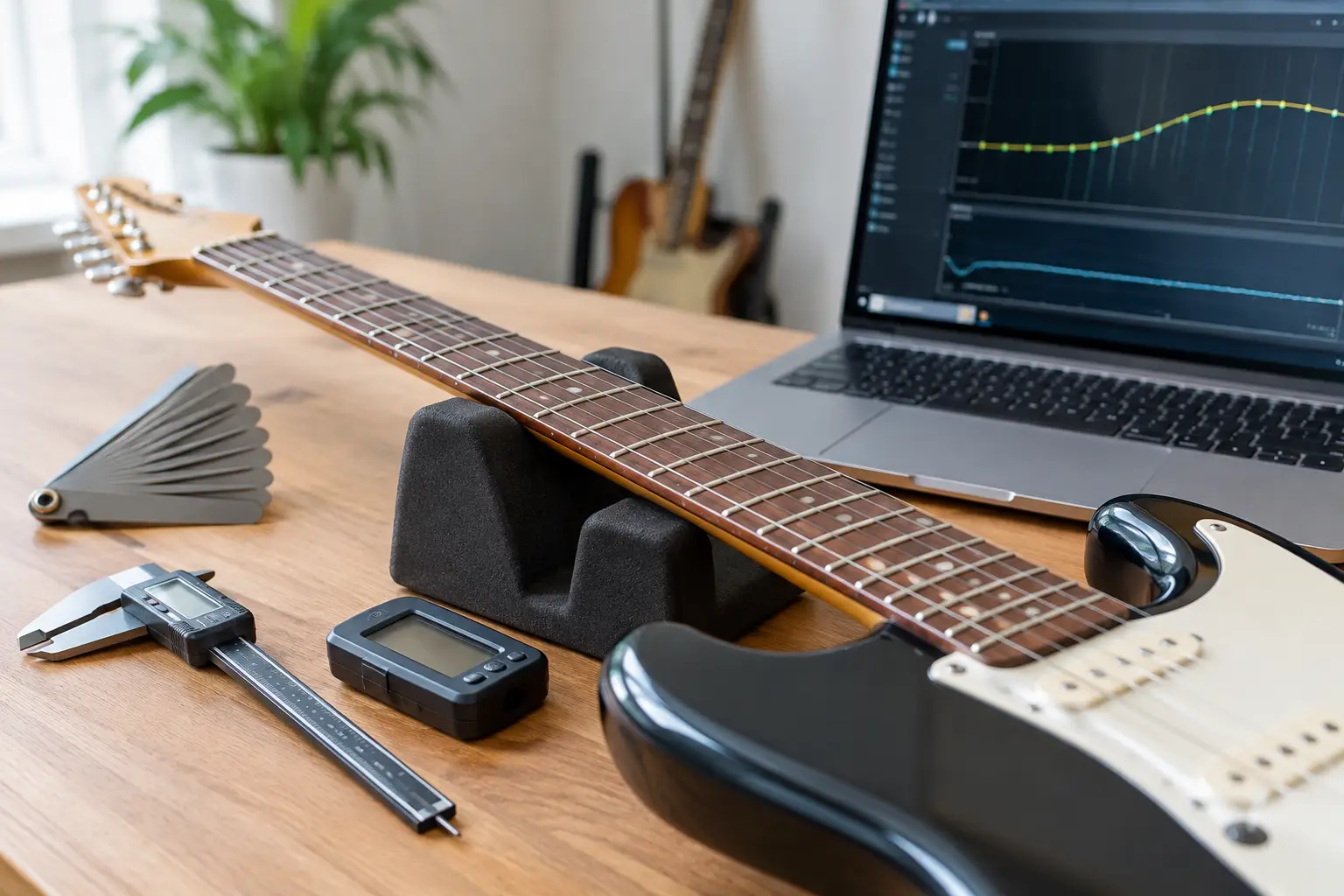
A guitar can measure neatly at the 12th fret and still feel wrong in the hands. That is why digital guitar setup measurements are more useful than a single action figure copied from a chart. They show how the neck, frets, strings and bridge behave together, then give the technician a dependable starting point for a setup built around the player.
For a light-touch electric player, low action may be the priority. For a hard-hitting rhythm guitarist, a touring bassist or someone using dropped tunings, clean headroom and stable pitch may matter more. The measurement is not the finished result. It is evidence that helps explain what the instrument needs.
What digital guitar setup measurements actually show
A proper setup is a sequence of related adjustments, not a quick tweak at the bridge. Neck relief affects the room available for a vibrating string. Fret level determines whether low action is realistically achievable. Nut-slot height influences the feel and tuning of the first few frets. Bridge height, saddle position and pickup height each have their own effect on playability and tone.
Digital measuring tools make small changes visible and repeatable. A full-neck relief map, for example, records the shape of the neck rather than relying on a rough visual check or one reading near the middle. This is particularly valuable on guitars with tension-dependent fret problems: an instrument may appear acceptable on the bench, then buzz in a familiar position once the strings are brought to pitch.
At RG Guitar Tech, the purpose of that detail is straightforward: identify the mechanical cause before adjusting around the symptom. It avoids raising the action unnecessarily when one high fret, an uneven fret run or an unsuitable relief setting is the real issue.
Neck relief: measuring the working curve
Neck relief is the slight forward curve created when string tension pulls against the truss rod. It is usually checked with the strings tuned to pitch, using the string itself as a straight reference and measuring the clearance over a selected fret. Digital gauges allow this clearance to be read precisely in millimetres rather than guessed.
There is no universal correct figure. A lightly played electric guitar with level frets may work well with very little relief. A bass with heavy strings, a low tuning and a forceful right hand will often need more. The useful question is not, “What number should every guitar have?” It is, “How much clearance does this neck need for this player’s string movement?”
Relief also needs to be assessed across the neck. A neck can have an acceptable reading around the seventh fret but still carry a local rise, dip or twist elsewhere. Full-neck digital mapping makes these patterns easier to spot. It can reveal why notes choke during bends high up the neck, why the bass strings buzz only around certain positions, or why an apparently low-action guitar feels inconsistent from one end of the fingerboard to the other.
Relief is not a cure for uneven frets
Adding relief can reduce buzz in part of the neck, but it is not a substitute for sound fretwork. Too much relief often leaves the lower positions feeling stiff and makes the action climb unnecessarily in the middle of the neck. If the readings point to uneven fret heights or poor fall-away, the honest answer may be fret levelling, dressing or geometry correction rather than another truss-rod adjustment.
Action readings need context
String action is normally measured from the top of the fret to the underside of the string, commonly at the 12th fret. It is one of the most familiar setup figures, but it is also one of the easiest to misunderstand.
A low measurement is only useful if the guitar plays cleanly enough for its intended job. An electric guitar used for fluid lead work may suit a lower action than a steel-string acoustic played with a heavy plectrum. A seven-string in a low tuning needs enough room for the wider movement of its lower strings. Vintage instruments can have limitations imposed by fret condition, fingerboard geometry, bridge design or neck-set angle.
Action should therefore be measured on both bass and treble sides, after relief has been set and with the intended strings fitted. Changing from .009s to .011s, moving to a lower tuning or swapping a plain third for a wound third can all alter the result. A useful written report records the final string gauge, tuning, relief and action, so the setup is not reduced to a vague description of “nice and low”.
Nut-slot height and the first-position test
Many guitars that feel difficult to fret near the nut have action readings that look perfectly reasonable at the 12th fret. The problem is often excessive nut-slot height. When the string starts too high above the first fret, first-position chords require more pressure and notes can pull sharp even when the bridge intonation is correct.
The slot must be cut with the correct width, angle and string-contact point. A slot that is too tight can cause tuning instability, especially with wound strings or tremolo use. One that is too low may create open-string buzz. Digital checks help establish clearance over the first fret, but the final judgement comes from playing open strings, first-position chords and bends in the way the owner actually plays.
This is one area where a generic factory specification can be misleading. A player who uses a hard attack may prefer a little more clearance than someone with a very controlled touch. The aim is clean, comfortable first-position playing without making the guitar feel unnecessarily high or sharp.
Under-string fret assessment and fall-away
A fret rocker can identify a local high fret, but it only checks small sections at a time. Under-string fret assessment adds another useful view: it examines the frets in the conditions that matter, with the strings applying normal tension. This can expose issues that change once the instrument is strung and tuned.
Digital fret measurement can show whether a problem is isolated or part of a wider pattern. A single raised fret may need seating and dressing. Multiple uneven frets may call for a level and crown. A rise where the neck meets the body can prevent low action in the upper register, while insufficient fall-away may make bends choke above the 12th fret.
Fall-away is the slight, controlled reduction in fret height towards the upper end of the fingerboard. Not every instrument needs the same amount, and it should never be introduced casually. When appropriate, though, it gives bending notes space to ring without forcing the whole guitar to sit higher.
Intonation is measured after the geometry is settled
Intonation compares the open string with its fretted reference note, usually at the octave. The saddle is moved to correct the speaking length of the string. This process only makes sense once the neck relief, action, strings and nut condition are broadly correct.
If action is changed after intonation, the fretted note will usually change too. If the nut slot is high, lower-position notes may still play sharp despite a correct octave reading. Worn strings, poor winding on the tuner post and a binding nut can also give unstable tuner readings, making it impossible to set a reliable result.
Intonation has practical limits. Standard fretted instruments use equal temperament, so no setup makes every chord perfectly pure in every position. The objective is accurate, consistent tuning across the areas of the neck and chord shapes the player uses most. A gigging guitarist who lives around open chords may need a slightly different compromise from a player recording high-register parts.
Pickup height belongs in the final measurements
Pickup height is often treated as a cosmetic finishing step, but it affects output balance, attack and sustain. Pickups set too close to the strings can create harshness, uneven volume and, with strong magnetic designs, unwanted pull on the strings. Too low, and the guitar can lose presence and balance between pickups.
Measurements provide a repeatable baseline from the fretted string to each pickup pole or cover. From there, the guitar is played through an amplifier and checked for string-to-string balance, clean response and the way the pickup behaves under gain. The final setting should serve the instrument and the player, not merely match a number in a manual.
When a setup becomes repair work
Digital readings are also valuable because they establish when adjustment alone will not solve the problem. A truss rod with limited movement, a warped neck, worn frets, a lifting fingerboard, slipping tuners or a bridge that will not hold its position all need a different response.
A candid diagnosis protects both the instrument and the player. There is little value in promising ultra-low action on a guitar with significant fret wear, or repeatedly correcting tuning when the actual fault is a damaged nut slot or unstable machine head. Repairing the cause first produces a setup that stays put.
The best digital guitar setup measurements are the ones that disappear once you start playing. You should notice the clean bends, comfortable chords, accurate tuning and dependable feel – then simply trust the instrument when it matters.