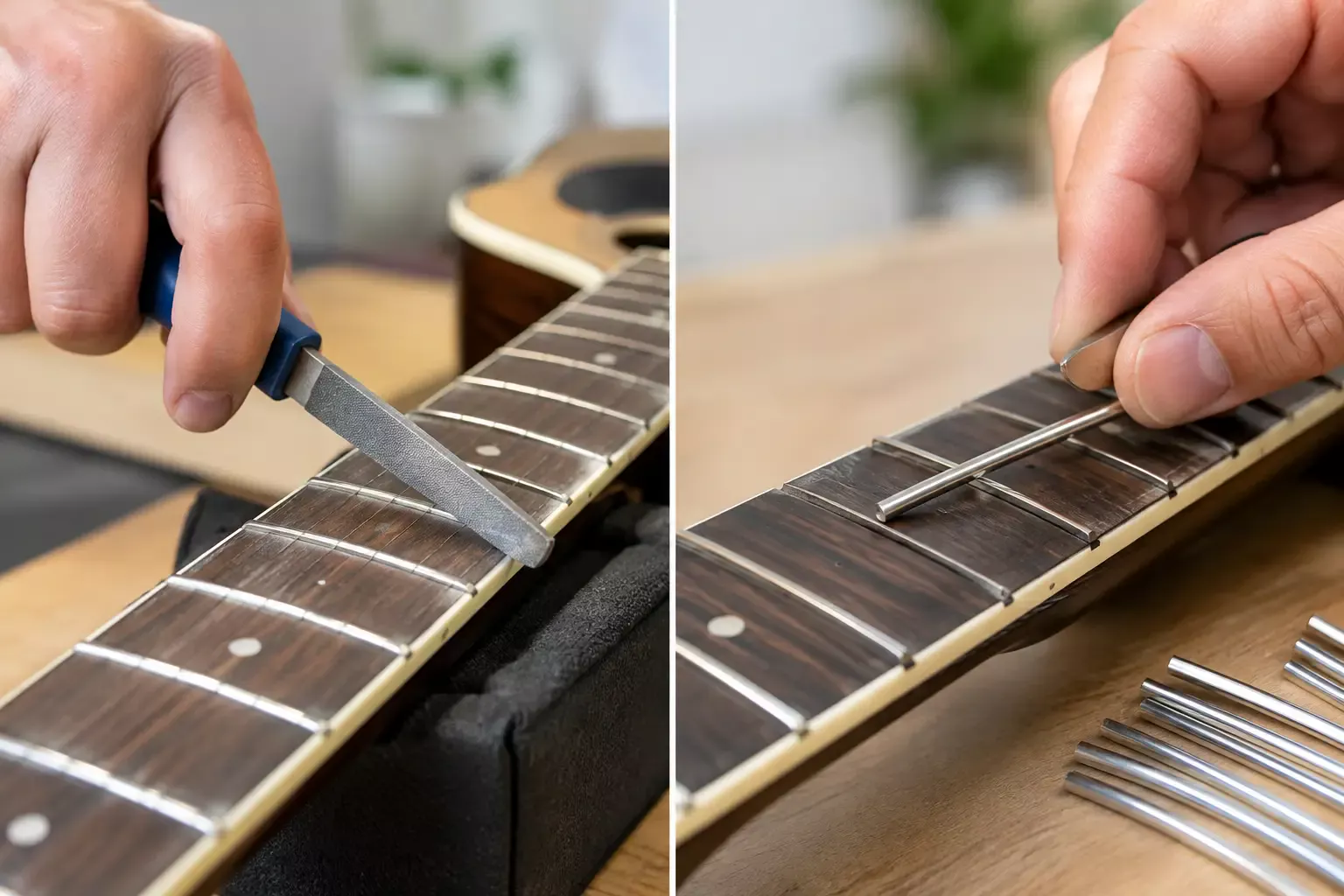
A guitar that once played cleanly can start fighting back in very specific places: a choke on the 12th-fret bend, a buzz around the first few frets, or a note that dies despite a sensible action. Guitar fret dressing versus replacement is the decision behind many of these repairs, but the right answer is not determined by age alone. It comes down to remaining fret height, wear pattern, neck geometry and the playing result you need.
A fret dress can restore an uneven but serviceable fretboard to clean, reliable playability. A re-fret replaces worn frets altogether and provides a fresh working surface. Both are precision jobs, and both need to be followed by a proper setup. The key is not choosing the larger repair by default, but choosing the repair that leaves enough usable fret material and gives your guitar a stable future.
What a fret dress actually corrects
Fret dressing is often used as shorthand for fret levelling, crowning and polishing. The process begins with diagnosis. Before removing material, a technician checks neck relief, string action, nut-slot height and the fretboard’s overall geometry. A guitar with incorrect relief or a high nut can appear to have fret problems when the issue is partly setup-related.
Once the neck is set to the correct working condition, the fret tops are assessed across their full length. Localised high frets, shallow grooves and uneven wear can then be levelled. The tops are re-crowned so each fret has a defined string-contact point, then progressively polished. That contact point matters: it is central to accurate intonation, clean notes and a smooth feel under bends.
A well-executed dress does not merely make the frets shiny. It creates a consistent fret plane that supports lower, cleaner action without random buzzes or notes choking out. On guitars that have seen regular gigging, especially those played hard in the lower positions, this can make the instrument feel notably more controlled and responsive.
When dressing is the sensible repair
Dressing is usually appropriate when the frets still have adequate height after levelling. Mild to moderate string grooves, isolated high spots, flattening on the crown and slight unevenness are all normal candidates. It is also often the better choice where preserving originality matters, such as a vintage instrument with healthy original fretwire.
The benefit is that only the minimum material needed to restore level is removed. However, that last point is also the limitation. Every level lowers all frets to match the lowest usable areas. If one or two deep grooves dictate the job, a full level may leave the whole neck with frets that are too low for comfortable future maintenance.
Guitar fret dressing versus replacement: the practical difference
The decision is best understood as a question of remaining margin. A fret dress corrects the surface you have. Replacement creates a new surface to work from. Neither is automatically better, and a responsible recommendation should be based on measured condition rather than a quick look at the first-position frets.
With a dress, you retain the existing fretwire, binding treatment and much of the instrument’s original character. It is generally less invasive than a re-fret and can be excellent value when the fret height supports it. It is particularly effective when a guitar has developed unevenness through seasonal movement, a few raised frets or normal playing wear rather than severe erosion.
With replacement, the old fretwire is carefully removed, the fretboard is assessed and corrected where necessary, and new wire is installed, levelled, crowned and polished. The guitar is then set up for its intended strings, tuning and player. It is more involved work, but it gives a heavily worn instrument a proper reset rather than asking too little material to do too much.
Signs your guitar may need a re-fret
Deep grooves are the clearest warning sign, especially beneath the plain strings around frets one to seven. If a groove is deep enough that levelling it out would leave very low, broad fret tops, replacement becomes the more durable option. Very low existing frets, repeated previous fret dresses and widespread flat crowns point in the same direction.
A re-fret may also be preferable when the player needs a particular fretwire size or feel. Moving from very narrow, low wire to a taller or wider profile can change how securely bends register, how clearly notes separate and how the guitar responds to a firm fretting hand. This is not automatically an upgrade. Taller frets can feel excellent for some players but expose heavy-handed intonation habits for others.
There are structural considerations too. Loose frets, fret ends lifting, a worn fretboard surface, old glue residue or poor seating can make a simple level a false economy. On bound necks, lacquered maple boards and vintage guitars, the approach must be planned carefully because preserving edges, finish and original details affects both the work and the result.
Do not blame every buzz on worn frets
Fret wear is only one cause of poor playability. A buzz that appears after changing string gauge may be caused by reduced neck relief. A rattle on open strings can come from nut slots cut too low. A problem that only occurs when the guitar is plugged in may be mechanical vibration elsewhere, rather than fret contact at all.
This is why assessment under realistic string tension matters. The neck does not behave exactly the same with strings removed, and some fret issues reveal themselves only when the instrument is tuned to pitch. Mapping relief and checking fret behaviour under strings helps separate tension-dependent fret problems from basic setup errors.
At RG Guitar Tech, that diagnosis is measurement-led rather than guesswork-led. Full-neck relief readings and under-string fret assessment help identify whether the problem is isolated, whether it follows the neck’s geometry, and how much material can safely be removed. The aim is to avoid both unnecessary re-frets and overly aggressive levelling.
The setup after fretwork is not optional
A fret dress or re-fret changes the playing surface, so the final setup is where the repair becomes a guitar that works for you. Neck relief, action, nut-slot relationship, bridge height, pickup height and intonation need to be checked together. Lower action may now be achievable, but the correct target still depends on how you play.
A player using heavy strings in standard tuning, a jazz guitarist with a clean touch and a touring rock player digging into wide bends will not necessarily want the same figures. Drop tunings, capo use, slide work and aggressive picking all change what counts as a clean setup. The goal is not the lowest possible measurement on paper. It is reliable, musical clearance with the feel and attack you expect.
For bass players, fret condition is just as relevant but the symptoms can be different. Worn or uneven frets may produce inconsistent sustain, rattling that changes with attack, or notes that lose definition higher up the neck. A bass setup also has to account for string mass, scale length and the player’s preferred balance between controlled growl and clean fundamental.
How to decide before authorising work
If your guitar has buzz, dead notes or visible grooves, avoid assuming that a re-fret is inevitable. Ask for the fret height to be assessed after the neck has been checked at tension. A clear report should explain whether the fretboard needs local correction, a full level and dress, or replacement, as well as any setup issues contributing to the problem.
It is also worth being candid about how you use the instrument. Mention the string gauge, tuning, action preference and whether it is a home guitar, a regular gigging instrument or a valuable original example. Those details can change the recommendation. A modest dress may be ideal for a carefully played vintage guitar, while a hard-worked stage instrument with exhausted fretwire may deserve a re-fret that will stay dependable for years.
The best repair is the one that gives you clean notes, accurate intonation and confidence in every position without removing more original material than necessary. If the diagnosis is clear and the work is matched to your playing, the guitar should stop demanding attention and get back to doing its job.