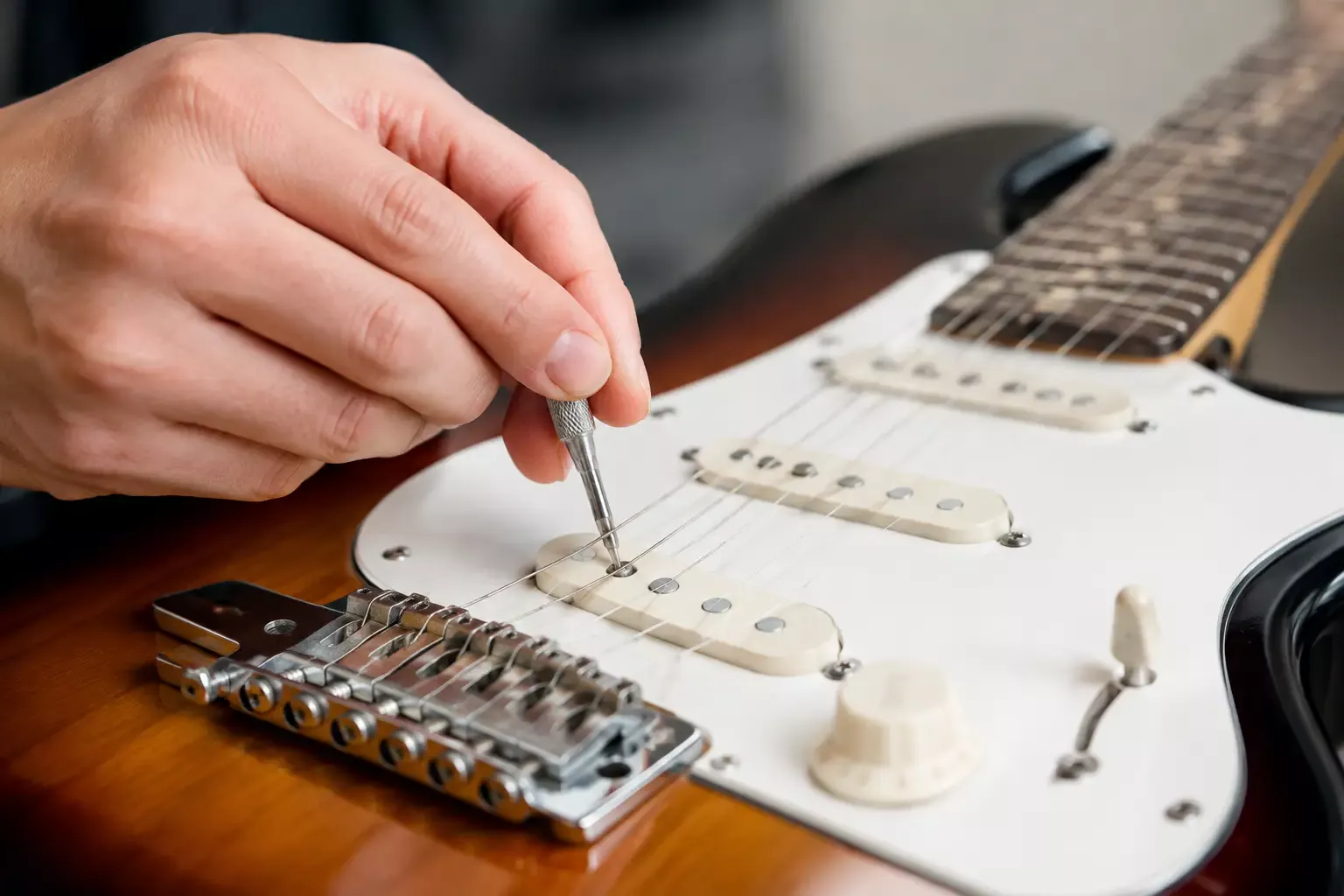
A guitar can have clean fretwork, sensible action and accurate intonation, yet still sound strangely weak, harsh or uneven between strings. Before replacing pickups or chasing faults in the wiring, check their distance from the strings. Learning how to set pickup height is one of the simplest ways to bring back definition, balance and usable output – provided it is done by ear as well as by measurement.
Pickup height is not a cosmetic adjustment. It changes the relationship between the string’s vibration and the pickup’s magnetic field. A few turns of a height screw can alter attack, sustain, string-to-string balance and how hard an amp or pedal is driven. Set too low, a pickup may sound thin and lack authority. Set too high, it can become boomy, brittle or physically interfere with the string’s vibration.
This guide applies to electric guitars and basses with magnetic pickups. Piezo-equipped acoustics, undersaddle systems and some specialist designs work differently.
What pickup height actually changes
A magnetic pickup senses movement in the string. Bringing it closer generally produces more output, a stronger attack and a more immediate sound. Moving it away reduces output, but can introduce more openness, clarity and dynamic range. Neither position is automatically right.
The trade-off matters most with neck pickups. Their position beneath a wider-moving section of string means they can become woolly or overly loud very quickly. Bridge pickups, where string movement is smaller, usually need to sit closer to achieve a comparable output level.
Pickup height also affects individual strings. The wound strings often need a little more distance than the plain strings because their greater mass can produce a stronger signal. However, the correct balance depends on the pickup design, string gauge, fretboard radius, picking force and the sound the player wants.
On a high-gain guitar, a closer bridge humbucker may supply the firm, immediate attack needed for tight rhythm work. On a clean Strat-style guitar, lowering the neck pickup may reveal clearer chords and stop the bass strings from dominating. The same instrument can need a different setting for a light-fingered player than it does for someone who strikes hard on stage.
How to set pickup height: start with a repeatable measurement
Do not measure from the top of the pickup cover to an open string. Open-string clearance changes with action, and it does not reflect the point at which the string comes closest to the pickup during normal playing.
Tune the instrument to pitch, hold the lowest and highest strings down at the final fret, and measure the gap between the underside of each string and the top of the relevant pole piece or pickup cover. Use a steel rule with millimetre markings or dedicated feeler gauges, keeping the rule upright rather than angled.
As a cautious starting point for many passive electric guitars, try approximately 2.0 mm on the treble side and 2.5 mm on the bass side at the bridge pickup. For a neck pickup, begin slightly lower – around 2.5 mm treble side and 3.0 mm bass side. These are starting figures, not a factory law.
Some high-output humbuckers, vintage low-output single coils, blade pickups and active systems are designed to work best at different distances. Always treat the pickup maker’s published specification as useful reference data. More importantly, assess the actual result on the guitar in front of you.
Set the guitar up before judging the pickups
Pickup height should be among the final adjustments in a proper setup. Neck relief, nut-slot height, fret condition, bridge action and string gauge all influence the available clearance and the way the strings vibrate.
If the action is later lowered by 1 mm, a pickup that was previously safe may suddenly be close enough to create magnetic pull or unwanted contact. Likewise, changing from light strings to a heavier gauge, or dropping the tuning, alters string movement and output. Recheck the pickup settings after any substantial setup change.
Adjust in small, equal steps
Most conventional pickups are raised or lowered with the mounting screws at either end. In many guitars, turning the screw clockwise raises the pickup and anticlockwise lowers it, but construction varies. Watch the pickup as you turn the screw rather than assuming.
Make adjustments in small increments: a quarter-turn per side is usually enough to hear a difference. Keep the pickup roughly parallel to the strings at first. Once the basic height is established, you can tilt it slightly to correct bass-to-treble balance.
Avoid forcing a stiff screw. Foam, springs, mounting tubing or ageing pickguard hardware can bind, especially on older instruments. If the pickup will not move freely, stop rather than stripping the screw head or damaging the mounting ear.
Balance the pickups before chasing perfect numbers
Select the bridge pickup, play a consistent phrase at your normal picking strength, then switch to the neck pickup without changing amp settings. The aim is not identical loudness in every position. The neck pickup often sounds naturally fuller, while the bridge may be brighter and more focused. What matters is that switching positions feels useful rather than causing a dramatic jump or drop in level.
Adjust the pickup that is out of proportion, then repeat the comparison. On guitars with a middle pickup, check every switch position, including the combined settings. A middle pickup that is too high can make the in-between sounds thin or strangely hollow; too low, and it can disappear when used alone.
For bass, judge the balance through an amp at realistic volume. Play each string from the first few frets through the upper register. A setting that sounds acceptable on open strings may reveal a weak G string or an overpowering E string higher up the neck.
If only one string is noticeably louder or quieter, do not immediately move the whole pickup. First check whether the pole pieces are adjustable, whether the string is seated correctly at the nut and bridge, and whether fret condition is affecting sustain. Individual pole-piece adjustment can be useful, but it should be approached carefully because it changes the pickup’s internal balance and, on some designs, is not intended as a broad height adjustment.
Listen for magnetic pull and false notes
Single-coil pickups with strong magnets are particularly prone to excessive magnetic pull when set too close. This is commonly heard on the bass strings around the 12th fret and above. Notes may warble, decay unevenly or seem slightly out of tune even when the intonation is correct. Players often describe the symptom as a strange chorus effect or a note that will not settle.
The cure is usually simple: lower the pickup, especially on the bass side, then test again. Do not try to correct this behaviour with saddle intonation. Intonation sets the speaking length of the string; magnetic pull disrupts how that string is allowed to vibrate.
Other warning signs of an over-high pickup include reduced sustain, harsh pick attack, distorted clean tones and a low string physically striking the pole pieces during hard playing. On a high-output humbucker, the problem may be less obvious as warbling but still present as compression and a loss of note separation.
A practical order for final voicing
Once you have a safe baseline, work through the same sequence each time. Set the bridge pickup first, as it establishes the guitar’s main output reference. Match the neck pickup to it, then bring in the middle pickup if fitted. Finally, make minor bass-side or treble-side changes while listening to chords, single-note lines and your normal gain setting.
Use your own rig where possible. A pickup height that sounds balanced through a clean practice amp may feel too aggressive into a driven valve amp, modelling rig or pedalboard. Also test at playing volume. Quiet bedroom levels can hide harshness and make a low pickup appear weaker than it will in a band mix.
Write down the final measurements. This is especially worthwhile for guitars used professionally, instruments that travel between rehearsals and gigs, or anyone still refining a preferred setup. A recorded baseline makes future string-gauge changes and seasonal adjustments far easier to manage.
When pickup height is not the real fault
A height adjustment cannot solve every output or tone problem. A weak position may indicate a failing selector switch, dirty pot, loose connection, damaged coil or a battery issue in an active instrument. Uneven sustain can also come from high frets, poor neck geometry, worn strings or a poorly cut nut.
If pickup changes produce no meaningful improvement, or the instrument has buzzes, dead notes and tuning problems alongside tone issues, it needs diagnosis rather than more screw turns. A measured setup identifies whether the limitation is the pickup setting, fretwork, neck relief, string-contact point or electronics.
The best pickup height is the one that gives your guitar clear notes, controlled output and a response that suits how you actually play. Start safely, move in small steps and trust the result under your fingers as much as the ruler.