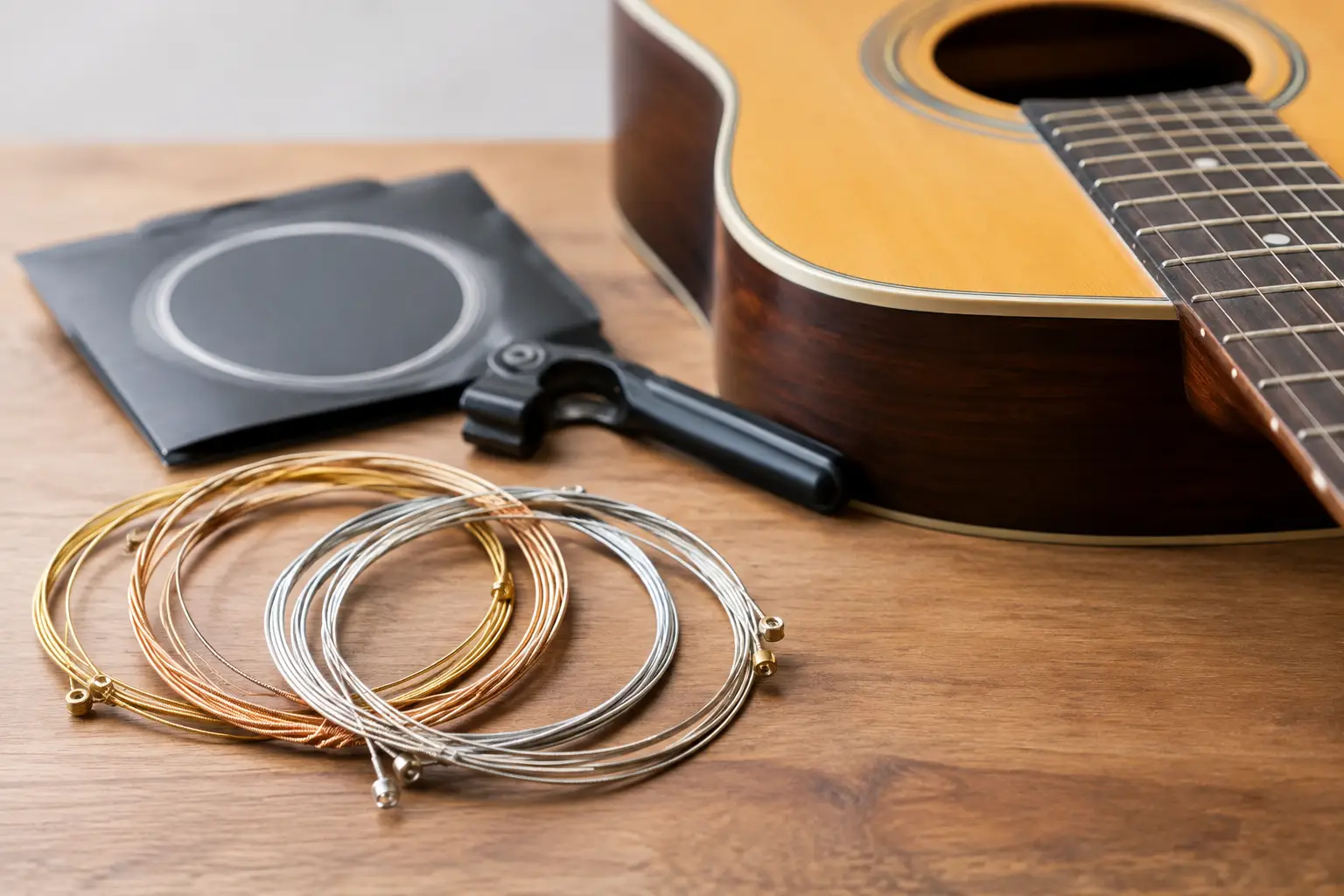
A guitar that feels perfect in E standard can become loose, sharp-sounding and unreliable after a move to drop C. That is why the best string gauge for guitar tuning is not one fixed answer or a packet recommendation. It is the gauge that provides suitable tension for your scale length, technique and preferred action, then allows the guitar to be set up accurately around it.
Changing gauge or tuning changes more than feel. It alters neck relief, bridge balance, nut-slot contact, intonation and, in some cases, the way strings clear the frets. A good setup treats these as connected measurements, not separate problems.
Best string gauge for guitar tuning: start with tension
String gauge is only one part of the tension equation. Scale length matters just as much. A .010 set on a 25.5-inch scale Fender-style guitar will feel firmer than the same set on a 24.75-inch Gibson-style guitar, because the longer scale stretches the strings further to reach pitch.
Tuning down reduces tension. Moving every string down one whole step from E standard to D standard cuts enough tension that a familiar set can feel noticeably softer, particularly on the wound strings. Moving up in gauge restores that resistance, but it also increases the load on the neck and can expose a nut that is too tight for the new strings.
Your playing style decides where the useful tension range sits. A player who uses wide blues bends may prefer a lighter plain-string gauge than a hard-picking rhythm player in the same tuning. For high-gain riffing, a stable low string and controlled pick attack often matter more than an especially light feel. There is no benefit in fitting the heaviest strings possible if the guitar becomes tiring to play or the top strings lose the bendability you rely on.
Useful gauge ranges for common tunings
The following ranges are sensible starting points for a typical six-string electric guitar. They are not rules. A 24.75-inch guitar, a floating bridge, heavy hands or a very low-action preference may move the decision one way or the other.
- E standard: .009-.042 suits a light touch and expressive bending; .010-.046 is the dependable middle ground for many players; .011-.049 adds a firmer, fuller feel.
- Eb standard: .010-.046 often feels close to .009s in E; .011-.049 gives a more substantial feel without becoming excessive on most guitars.
- D standard: .011-.049 or .011-.052 usually provides a balanced response; .012-.054 suits forceful picking and players who do not need easy, wide bends.
- Drop D: .010-.046 can work well, though a .046 or .048 sixth string is generally more controlled; .010-.52 sets give the low D extra authority while retaining familiar top strings.
- Drop C and C standard: .011-.052 is a workable lighter option on a 25.5-inch scale; .011-.56 or .012-.56 is often more stable, especially for palm-muted rhythm work.
- B standard and lower: .012-.60, .013-.62 or a purpose-built baritone set may be appropriate. At this point, scale length is often the deciding factor, not simply a bigger low string.
For seven-string guitars, the same principle applies. In B standard, many players land somewhere around a .059-.064 low B, depending on scale length and picking force. An 8-string in F# or lower commonly needs a longer scale and a carefully chosen low string to avoid a dull, unstable response. Very heavy strings do not automatically solve low-tuning problems if the instrument’s scale length is too short for the register.
Why the low string is not the whole story
A common mistake is to fit one very heavy sixth string while leaving the rest of the set unchanged. That may tighten a floppy low C, but it can leave a large tension jump between the fifth and sixth strings. The guitar then feels uneven across the neck, and chord shapes can respond inconsistently.
Balanced-tension sets can help, but they are not mandatory. Many players deliberately use a heavier bottom end because their rhythm work needs it. The useful test is musical rather than theoretical: can you pick a clean low note without it wandering sharp, does it return to pitch after hard palm muting, and does the transition between strings feel natural under the hand?
Plain strings deserve equal attention. A set with a .011 first string may be ideal in D standard for a player who picks hard and bends modestly. Another player may prefer a custom set with a .010 first string and heavier wound strings, keeping lead work comfortable while stabilising the lower register. That is a valid choice, provided the setup is adjusted to match.
Gauge changes require a proper setup
A guitar is adjusted to live within a particular tension range. Fit heavier strings and the neck may pull forward, increasing neck relief and raising the action through the middle of the fingerboard. Fit lighter strings or tune down, and the neck can straighten or move into back-bow, producing open-string buzz and fret rattle around the first few positions.
The truss rod should not be adjusted by guesswork. Relief needs to be measured across the full neck, because a local high fret, uneven fret wear or insufficient fall-away can imitate a simple relief problem. Raising the action may hide the noise, but it does not necessarily address the cause.
The nut is another frequent issue. A heavier string may bind in a slot cut for a lighter gauge. Symptoms include a ping when tuning, notes that return sharp after bending, and tuning instability on open chords. The slot must be widened to suit the string while retaining the correct depth, angle and string-contact point. Cutting it too low creates its own open-string buzz problem.
Bridge adjustment follows. Fixed-bridge guitars may need saddle-height and intonation corrections. On Floyd Rose and other floating systems, changing gauge or tuning also changes the balance between string tension and spring tension. The bridge angle has to be reset before final action and intonation measurements mean anything.
Intonation is not optional after retuning
If you move from E standard to drop C and leave the saddles untouched, the guitar may tune accurately at the open strings but play sharp or flat higher up the neck. This is especially obvious with heavy chords, layered recordings and keyboards. Intonation is affected by gauge, tuning, action height and the point at which each string leaves the saddle.
There is a limit to what saddle movement can correct. Worn frets, poor nut geometry, a warped neck or unsuitable action can prevent a guitar from intonating cleanly. That is why a proper setup checks the whole geometry before treating the bridge saddles as the answer to every pitch issue.
For acoustic guitars, gauge changes need the same care. Heavier strings can add volume and drive the top more strongly, but they also add tension to the neck and bridge area. Light acoustics may feel easy under the fingers but can lose headroom when played hard. A well-cut nut, sensible relief and clean saddle contact are particularly important because there is less adjustment available than on most electrics.
Choose for the guitar you actually play
Start with the tuning you use most, not the tuning you visit for one song. If a guitar spends nearly every rehearsal in drop C, set it up for drop C. Constantly moving between E standard and low tunings on one instrument is possible, but it requires compromises in tension and intonation. A second guitar dedicated to the lower tuning is often the more reliable solution for gigging players.
Consider the instrument’s condition as well. Fret wear, an uneven fingerboard, a poorly cut nut or a weak tuner can all become more obvious after a gauge change. Strings are often blamed for a mechanical problem that was already present.
A useful starting point is .010-.046 for E standard, .011-.52 for drop D or D standard, and .011-.56 or .012-.56 for many drop C guitars. Treat those as starting measurements, then refine them around your scale length and hands. If the guitar is fighting you, sounding unfocused or refusing to hold pitch, a measured setup is more useful than another random packet of strings. For Nottingham players and guitarists using a repair-by-post service, RG Guitar Tech can assess the instrument around the gauge and tuning you genuinely use, with the completed measurements documented for future reference.
The right set should disappear beneath your fingers: firm enough to speak clearly, comfortable enough to play for a full set, and stable enough that you can concentrate on the music rather than the tuning pegs.