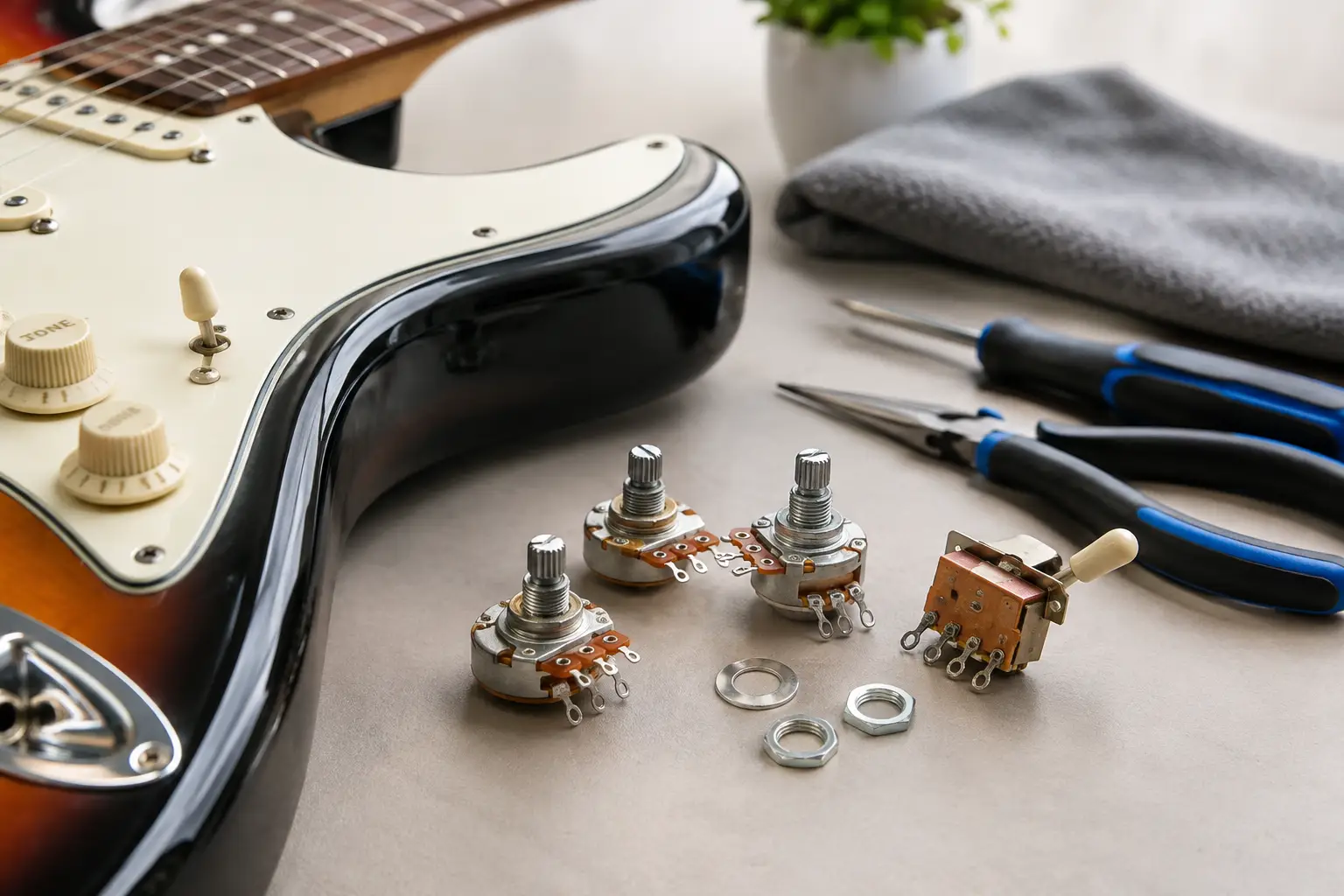
A volume control that crackles halfway through a song, or a selector switch that cuts out when the guitar moves, is more than a minor irritation. It puts an otherwise good instrument at risk of becoming unreliable when it matters. Proper guitar pots and switch repair is about finding the real source of the fault, then restoring dependable control without changing the character of the instrument unnecessarily.
For players in Nottingham, a noisy control can be particularly frustrating because the symptom is often intermittent. The guitar may behave perfectly on the bench, then lose signal during rehearsal. A careful diagnosis separates a dirty contact from a worn component, a poor solder joint, a socket fault, or a problem elsewhere in the wiring loom.
What Guitar Pots and Switch Repair Actually Covers
Potentiometers, usually called pots, control volume and tone. Inside each is a resistive track and a moving contact called a wiper. As the knob turns, the wiper changes the electrical resistance and therefore alters the signal reaching the output. When that track is contaminated, worn or damaged, the result may be crackling, signal loss, uneven taper or a control that works only in certain positions.
A pickup selector switch routes the signal from one pickup, or a combination of pickups, to the rest of the circuit. Blade switches, toggle switches and rotary selectors all have moving contacts. Dirt, oxidation, worn contact plating and weak spring tension can all create dropouts. On older instruments, the switch itself may be sound while the connections to it have become fragile.
The job can also involve output sockets, capacitors, wiring, grounding and pickup leads. Electronics should be treated as a circuit, not as a collection of separate parts. Replacing a pot may cure the immediate noise, but it will not solve a loose earth connection or a worn output socket that is causing the same symptom.
Symptoms Worth Checking Before a Gig
Not every crackle means a part has failed. A light scratch when turning a pot that disappears after cleaning may be contamination. A loud pop, complete signal loss or repeated cutting out points to a more definite fault. These are the signs that deserve investigation:
- crackling or scratching when the volume or tone control is turned
- a pickup dropping out in one selector position
- sound returning when the switch or lead is moved
- reduced output, thin tone or an unusually dark sound
- intermittent hum that changes when a control plate or jack socket is touched
- a control that spins freely, feels stiff, or has a loose shaft
The way the fault behaves matters. If the sound disappears when the cable is touched, the output socket may be the issue rather than the switch. If one pickup is consistently silent but the others work, the fault could be at the pickup, its lead, the selector contact or the associated solder joint. Good repair begins with this distinction.
Diagnosis Before Parts Are Ordered
An experienced repair starts with a functional test through a known-good lead and amplifier, followed by inspection of the control cavity, wiring routes and jack socket. The instrument is tested in every pickup position, with each control moved slowly through its full travel. This reveals whether the fault occurs at a specific point or under physical movement.
Continuity and resistance readings help confirm what the ear suggests. A multimeter can identify a broken connection, an open circuit, a poor earth path or a pot whose value has drifted well outside a useful range. The control is also checked for its stated value and taper. A 250k audio-taper volume pot behaves differently from a 500k linear-taper control, and fitting the wrong replacement can make a guitar feel abrupt, overly bright or unusually dull.
Visual inspection is equally useful. Old solder joints can become dry or cracked, particularly where cables have been pulled or where a cavity has been repeatedly opened. Shielding can touch a hot connection. A wire may be trapped beneath a scratchplate screw. These faults can appear simple, but replacing components before locating them can add cost without adding reliability.
Clean, Repair or Replace?
Contact cleaner is useful when applied for the right reason. A quality electrical contact cleaner can remove light contamination from a pot or selector, allowing the moving contacts to operate cleanly again. It is not a permanent cure for a worn resistive track, weak switch spring, bent contact or loose internal mechanism.
Cleaning is usually sensible where the component is otherwise mechanically sound, the fault is mild, and retaining original parts matters. This can be particularly relevant to vintage instruments, where original hardware contributes to originality and value. The trade-off is that a heavily used original pot or switch may remain less dependable than a new, correctly specified component.
Replacement is the better option when a pot has dead spots, a selector is physically loose, contacts have lost their tension, or the fault returns shortly after cleaning. It is also appropriate when a component has been poorly modified in the past. A reliable replacement should match the guitar’s electrical requirements, shaft type, physical dimensions and control layout. There is no benefit in fitting a premium part if it does not sit correctly under the knob or suit the circuit.
Why Component Choice Changes Tone and Feel
Pot values influence how much high-frequency content is loaded from the pickups. Many single-coil guitars use 250k pots to keep brightness controlled, while humbucker-equipped instruments often use 500k pots for a more open top end. That is a starting point rather than a rule. Pickup output, magnet type, capacitor value, cable capacitance and the player’s preferred amp settings all affect the result.
Taper matters just as much in use. Audio, or logarithmic, taper pots generally give a more natural-feeling volume sweep because human hearing does not respond to level changes in a linear way. A linear pot can make the first part of the turn feel as though very little is happening, followed by a rapid change near the end. Some circuits deliberately use linear taper for tone controls, but the correct choice depends on the wiring and the player’s expectations.
Switch choice is not simply about the number of positions. A traditional lever switch may suit a Telecaster or Stratocaster layout, while a quality toggle is appropriate for many Gibson-style instruments. Compact import switches can fit cavities that will not accept larger replacements without alteration. This should be assessed before work begins, especially on instruments where preserving original woodwork is important.
The Repair Standard That Prevents Repeat Faults
Reliable electronics work is tidy, mechanically secure and serviceable in future. Wires should be routed so that they do not strain when a scratchplate or control plate is refitted. Solder joints need sufficient heat and clean surfaces to form correctly, without overheating the pot or melting insulation. Excess solder is not proof of strength; it can conceal a poor joint and make later work harder.
Grounding deserves particular care. Many hum complaints are not caused by the pickups themselves but by an incomplete earth connection, a loose bridge earth or inconsistent screening. At the same time, no amount of shielding will make a single-coil guitar entirely silent in every electrical environment. The aim is to remove avoidable noise while keeping the intended response of the instrument intact.
After repair, the guitar should be tested at playing volume and through every control setting, not merely checked for continuity. The cavity or scratchplate is refitted without pinching wires, controls are aligned, knobs are secured, and the output socket is checked with a jack plug under movement. If the instrument has been opened for broader work, a final play-test confirms that the electronics behave correctly alongside the pickup height, string action and normal playing dynamics.
When Electronics Faults Are Really Setup Problems
A player may describe a guitar as weak, thin or inconsistent when the root cause is mechanical. Pickup height that is too low can reduce output; pickup height that is too high can create harshness, magnetic pull and intonation issues. A poor string-contact point at the nut or saddle can sound like a signal problem when the note is actually losing clarity acoustically.
That does not mean electrical faults should be dismissed. It means the instrument needs to be assessed as a complete system. At RG Guitar Tech, electronic repairs are approached with the same measurement-led care as neck relief, fret condition and intonation, so the result is not just a working switch but a guitar that responds properly in the player’s hands.
If a control has become noisy, a selector is unreliable or the jack cuts out mid-song, do not wait for the fault to become permanent. A clear diagnosis and a properly finished repair can return the instrument to quiet, predictable, gig-ready service – leaving you free to think about the next note rather than whether the signal will arrive.