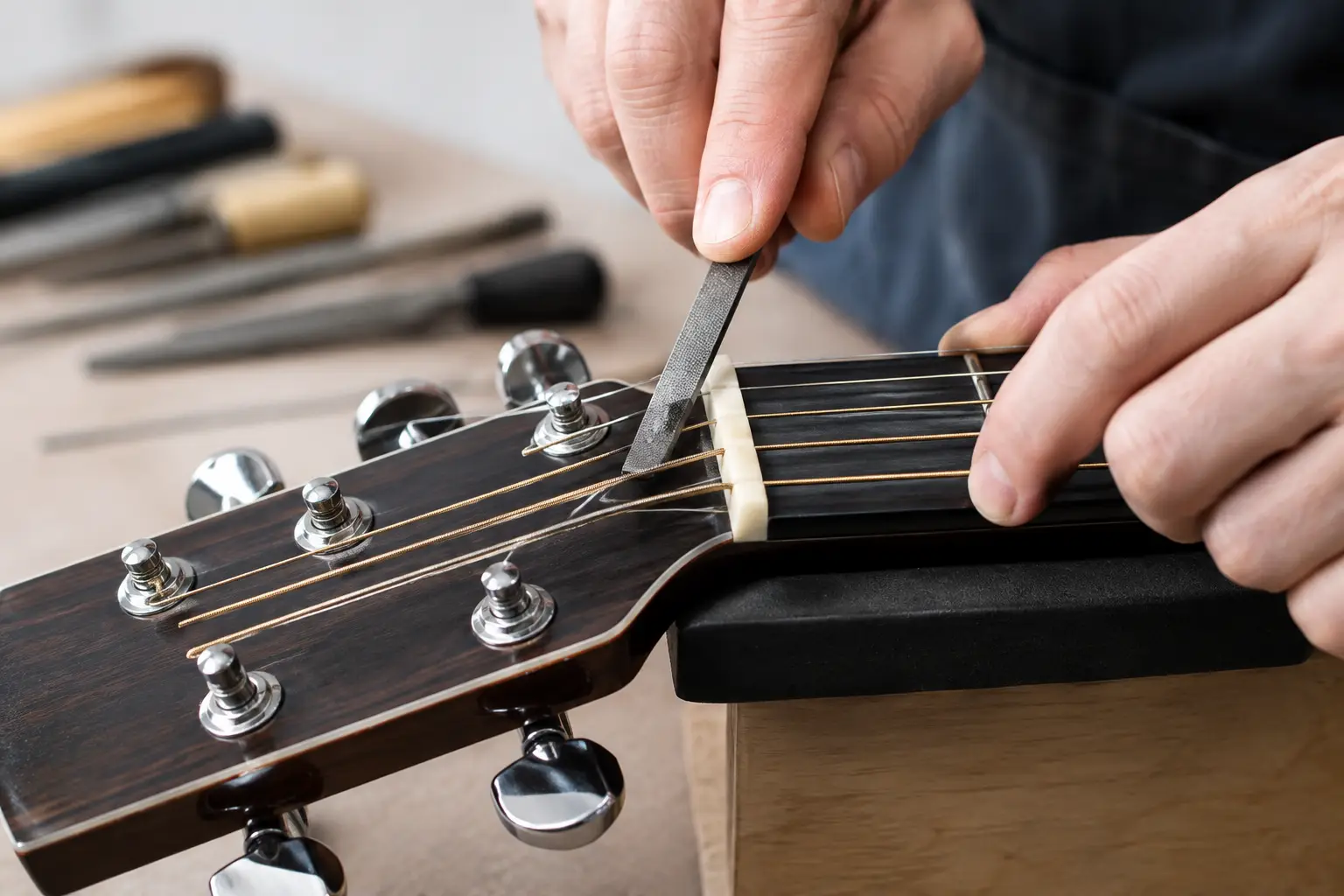
The first few frets should feel easy, tune cleanly and respond predictably. When an open-position chord feels stiff, notes go sharp after fretting, or a string pings as you tune, the cause is often at the nut. A guitar nut slot filing service addresses the small but critical contact points that set the starting height, path and release of every string.
This is not simply a case of making the slots lower. Each slot has to suit the guitar’s fret height, neck relief, string gauge, tuning, nut material and the player’s attack. Remove too little material and the guitar remains hard to fret in first position. Remove too much and open-string buzz can appear, often requiring repair or replacement rather than further adjustment.
What the nut does to your guitar’s feel and tuning
The nut establishes the string’s height over the first fret. It also forms the string-contact point before the string travels to the tuner. Those two jobs affect far more than open strings.
If a slot is too high, the player has to stretch the string farther to reach the fret. That extra stretch raises the pitch, particularly on the first and second frets. A tuner may show an open string as correct, yet an F chord can still sound noticeably sharp. Players sometimes compensate by pressing more lightly or retuning between songs, but neither is a proper fix.
A badly shaped slot can create a different problem. The string may bind within the slot, then release suddenly with a ping or jump in pitch. This is common on guitars with a three-a-side headstock, vibrato use, heavier strings or alternate tunings, because the string approaches the tuner at an angle. Lubrication can help a healthy slot move freely, but it cannot correct a slot that is too narrow, rough, poorly angled or damaged.
At the other extreme, a slot cut too low allows an open string to sit too close to the first fret. The result may be a sitar-like rattle, intermittent buzz or a loss of clear attack. It can be tempting to blame the truss rod or bridge action, but an open-string fault needs to be separated from a fretted-note fault before any adjustment is made.
How a guitar nut slot filing service is assessed
A proper nut adjustment begins with diagnosis, not the file. At RG Guitar Tech, the guitar is considered as a complete system: current string gauge and tuning, neck relief, fret condition, action, bridge geometry and the player’s requirements all influence the correct result.
The first check is whether the issue really belongs at the nut. Buzzing that appears only when a note is fretted can point to uneven frets, insufficient neck relief, a local high fret or a tension-dependent fret problem. A dead note further up the neck will not be cured by cutting a nut slot. Equally, poor tuning can come from tuners, a bridge saddle, string installation or an incorrectly cut nut.
Once the nut is identified as part of the issue, slot heights are measured against the first fret. The aim is low, comfortable action without allowing the open strings to rattle. The precise clearance depends on the instrument and playing style. A lightly picked electric guitar may tolerate a lower setting than an acoustic played hard with a plectrum, while a bass needs enough clearance for its larger string movement.
The slot widths are then checked against the fitted strings. A guitar set up for .009s cannot automatically be expected to perform correctly after moving to .011s or .012s. The heavier string can pinch in a previously suitable slot. Conversely, a narrow string sitting loosely in a wide slot may not be supported cleanly.
The shape matters as much as the depth
Professional nut files are selected to create a slot that supports the string without gripping it. The bottom of the slot must be clean and appropriately formed, with no sharp edges that catch the string. The fall-away from the contact point also needs to lead down towards the tuner side, helping the string leave the nut decisively rather than resting along an extended flat section.
This geometry is especially important on angled headstocks and guitars that use tremolo systems. A slot that appears acceptable from above can still cause tuning instability if its exit angle is wrong. The final contact point should be controlled, not accidental.
Material changes the approach too. Bone, synthetic materials, graphite-based nuts, brass and original vintage components all respond differently to filing and polishing. On a valuable or original instrument, preservation matters. If the existing nut is structurally sound, careful correction is usually preferable to unnecessary replacement. If it is cracked, excessively worn or already too low, an honest recommendation may be a new nut rather than an attempted rescue.
Hosco nut files and precise measurement
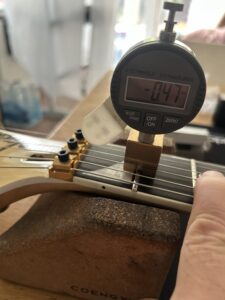
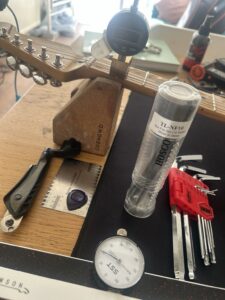
I use Hosco nut files, which I consider among the best available, and measure string clearances with a digital dial indicator (digital dial gauge). I don’t guess or file by eye: each nut slot must be cut precisely to suit the string and the guitar’s setup.
Problems that nut-slot work can genuinely fix
Nut-slot work is most useful when the symptoms match the cause. A well-executed adjustment can improve first-position comfort, reduce sharp fretted notes near the nut and make tuning changes more consistent. It can also remove the resistance and audible ping associated with binding strings.
Players often notice the difference immediately with cowboy chords, barre chords near the first fret and open tunings. The guitar requires less effort without feeling loose or fragile. Intonation at the bridge still matters, but correct nut height prevents the first few frets from fighting against an otherwise accurate setup.
It does not, however, make worn frets level, correct a twisted neck or solve every tuning issue. A guitar with deep fret wear, poor fall-away or unstable hardware may need broader work. This is why a nut service is best carried out within a measured setup rather than treated as an isolated cosmetic adjustment.
When a full setup is the better choice
Changing string gauge, tuning or playing style changes the balance of the instrument. If you have moved from standard tuning to drop C, fitted heavier strings for touring, or bought a used guitar with an unknown setup history, the nut should be assessed alongside relief, action, intonation and pickup height.
For example, lowering nut slots on a guitar with excessive neck relief may improve the first fret but leave the middle of the neck uncomfortable. Lowering the bridge to compensate can then expose high-fret issues. A full setup follows the right order: evaluate fret condition, establish neck relief, set nut action, adjust bridge action, set intonation, then play-test across the neck.
That sequence matters because each adjustment influences the next. It is also why generic measurements found online are only a starting point. A player who uses a heavy right hand, a slide, low tunings or aggressive vibrato needs a different compromise from someone who plays lightly at home or records intricate clean parts.
Warning signs that should not be ignored
Book an assessment if open strings buzz while fretted notes are otherwise clear, if first-position chords consistently sound sharp, or if a string catches during tuning and then jumps suddenly. Visible slot wear, cracks at the nut edge and strings sitting unusually deep in their slots also deserve attention.
Do not deepen a slot with improvised files, folded abrasive paper or a saw blade. It is easy to create a slot that is too wide, too low or angled in the wrong direction. Once the string sits below its proper height, material has to be restored or the nut replaced. What begins as a quick adjustment can become a more involved repair.
A written setup report is useful here because it records the work completed and the instrument’s measured condition. If you later change string gauge or tuning, there is a clear baseline for the next adjustment.
For players in Nottingham, Wollaton, Beeston, Kimberley, Ilkeston and further afield by post, accurate nut work is a practical investment in an instrument that feels predictable every time it comes out of its case. If your guitar makes you work too hard in the first few frets, let the measurements and the playing test decide what it needs.
For nut-slot advice or to book an assessment, contact Rob.