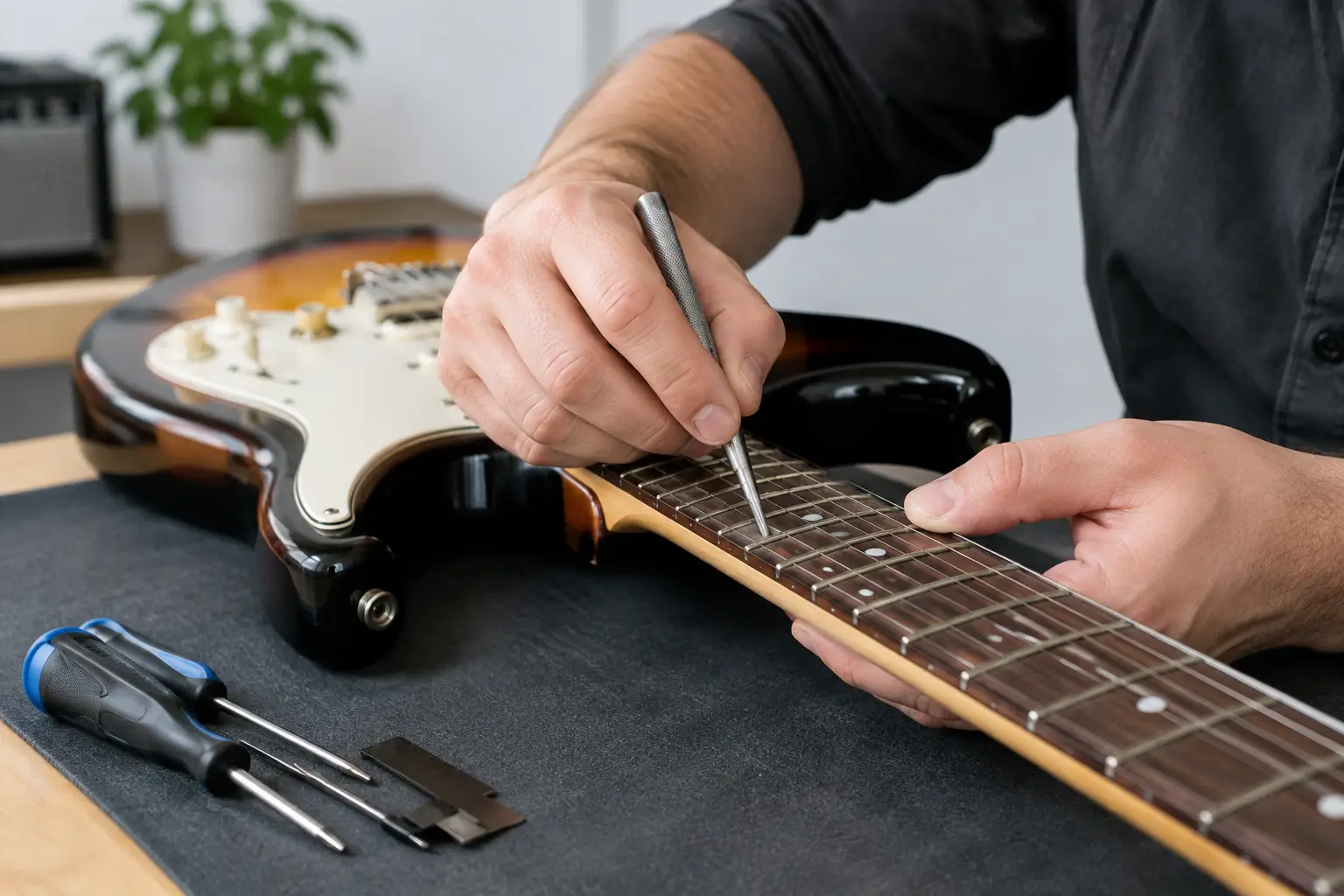
A note that dies halfway through a phrase is not a minor annoyance. It interrupts sustain, alters intonation and makes a guitar feel unreliable precisely where you need confidence. Proper guitar dead notes repair starts by identifying what is stopping the string from vibrating freely. Raising the action may hide the symptom, but it is not automatically the right repair.
A dead note can affect one fret, a small area of the neck or an entire string. It may choke immediately, decay much faster than neighbouring notes, or produce a metallic sitar-like rattle before disappearing. Those differences matter. The location, the string gauge, the tuning and the player’s attack all help point towards the actual cause.
What counts as a dead note?
Players often use “dead note” to describe any note that buzzes, but a true dead note is usually one whose vibration is interrupted by another fret. The string contacts a higher fret farther along the board, so it cannot complete its normal speaking length. On an electric guitar, the note may still appear through the amplifier, but it will have little sustain and a thin or choked character.
Not every short-lived note is a fret fault. Some guitars have natural dead spots caused by the way the neck and body resonate together. These are most noticeable on certain basses, commonly around the upper-middle register of the G string. A resonance-related dead spot may improve with changes in string mass, hardware or playing position, but it cannot always be removed in the same way as a high fret.
The first job is separating a mechanical obstruction from a resonance issue, weak pickup output or a note being damped by the player’s fretting hand. That is why a quick visual check alone rarely tells the full story.
Guitar dead notes repair: finding the cause
A reliable diagnosis begins with the guitar tuned to the player’s normal pitch and fitted with the intended string gauge. Neck relief, action and fret behaviour are tension-dependent. A guitar set up for 10-46 strings in standard tuning will not necessarily behave the same after moving to heavier strings, dropped tuning or a lighter touch.
The neck is then assessed across its full length rather than judged from one point. Digital relief mapping shows whether the neck has a consistent curve, a local rise or an irregular transition around the neck joint. Under-string fret assessment is especially useful because it reveals what the strings actually encounter at playing tension.
A high or lifted fret
One isolated dead note often points to a fret that sits fractionally higher than its neighbours. It may have lifted slightly from the fretboard, worn unevenly, or become prominent after seasonal movement in the wood. A fret does not need to look dramatically raised to choke a string. Very small differences become significant once the action is set low enough for comfortable playing.
If the fret is otherwise sound, it may be reseated and dressed locally. If several frets show inconsistent height, a measured level, crown and polish is normally the more dependable answer. The aim is not simply to remove metal. It is to create an even playing surface while retaining sensible fret height, clean crowns and accurate string-contact points.
Incorrect relief or action
Too little neck relief can make notes around the lower and middle positions rattle or choke, particularly with a firm picking hand. Too much relief can make the guitar feel stiff and high in the middle of the neck while still leaving issues higher up. Action that is set excessively low may expose small fret inconsistencies that were previously hidden.
A setup adjustment can resolve a dead-note complaint when the guitar’s geometry is basically healthy. However, it is not honest to keep raising saddles to work around a high fret. The player ends up with harder-to-play action, less consistent intonation and the original fault still present.
A rising fretboard extension or poor fall-away
Notes that die above the 12th fret often require closer inspection of the upper register. Many bolt-on guitars develop a slight rise where the neck meets the body. On acoustic guitars, the fretboard extension can also change with humidity, string tension and long-term movement. This is not always visible, but it can make bends choke and upper fretted notes vanish at a perfectly reasonable action.
Correct fall-away allows the fret surface to drop away very slightly towards the highest frets. It gives a vibrating string room to move as it is fretted higher up the neck. The amount required depends on the instrument, fretboard radius, action target and whether the player uses wide bends. It should be measured, not guessed.
Nut, bridge and hardware faults
A note played on an open string has a different set of possible causes. A nut slot cut too low can create an open-string buzz that disappears when the first fret is held. A badly defined witness point at the saddle, a loose saddle screw, worn bridge component or rattling tuner can also imitate a dead note.
These faults need checking before fretwork is proposed. A good repair is specific to the failing part. Replacing or adjusting the right component preserves the instrument and avoids unnecessary work.
Why seasonal changes can expose the problem
Wood moves. In the UK, indoor heating, damp weather and changes in storage conditions can alter neck relief and fretboard dimensions. A guitar that played cleanly in summer can develop sharp fret ends, reduced relief or a newly prominent fret during a colder, drier spell.
This does not always mean the instrument needs major repair. Sometimes a careful setup restores normal playability. Repeated movement, multiple lifted frets or a neck that will not hold a stable adjustment deserves a more thorough assessment. The important point is that the guitar should be evaluated in its present condition, at its working tension, rather than adjusted from a generic specification.
What can be checked safely at home?
Before arranging a repair, make a note of exactly where the fault occurs. Play the same fret on adjacent strings, then play the notes directly above and below it. Check whether the problem appears with normal picking only, or also with a light attack. If it happens mainly during bends, note the direction of the bend.
Also confirm that the strings are not old, kinked or badly seated at the nut and bridge. A fresh, correctly fitted set can remove misleading symptoms. If the guitar has recently changed string gauge or tuning, mention that when booking. It is relevant setup information, not a minor detail.
Avoid filing frets, deepening nut slots or turning the truss rod repeatedly in search of a quick cure. These adjustments interact. A truss rod is for setting neck relief, not for forcing a neck flat enough to compensate for uneven frets. Once material has been removed from a nut or fret, the repair can become more involved.
The repair should suit the instrument and player
There is no single action measurement that suits every guitar. A player with a light touch and 9-gauge strings may want a low, fast setup. A guitarist using heavier strings, dropped tuning and aggressive rhythm technique needs enough clearance for the string’s wider movement. The same applies to basses, extended-range instruments and acoustics.
At RG Guitar Tech, dead-note work is approached as part of the guitar’s full geometry: relief, fret plane, nut height, bridge action, intonation and pickup height are considered together. Completed setup work is documented, so the player has a clear record of what was measured and adjusted rather than a vague assurance that it has been “set up”.
For players in Nottingham, Beeston, Wollaton, Kimberley and Ilkeston, bringing the instrument in allows its feel and playing style to be discussed directly. Repair-by-post is also practical when the fault is clearly described and the guitar is packed securely. In either case, photographs or a short recording of the problem can be useful, but the final decision should be based on a hands-on assessment.
A guitar should not force you to avoid part of its fretboard. If one note consistently disappears, have the cause measured before accepting higher action as the price of living with it. The right repair leaves the instrument cleaner, more predictable and ready to respond when you need it to.