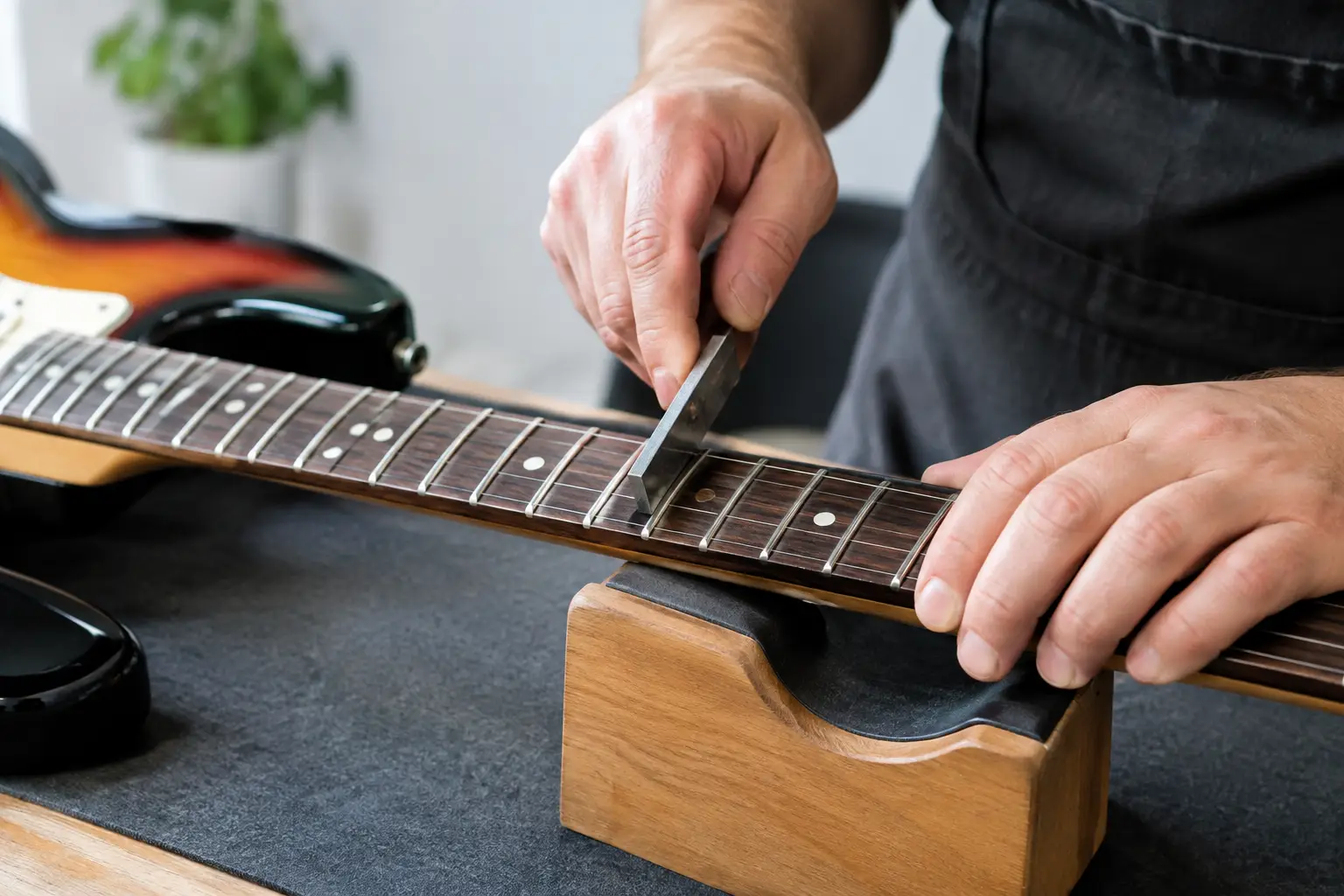
A guitar that once played cleanly can gradually become hard work. Bends catch or choke, open-position chords sound oddly sharp, and lowering the action only brings more buzz. A guitar refret service in Nottingham is the right next step when worn fretwire, rather than a routine setup, is limiting how well the instrument can play.
Refretting is a significant repair, but it is not a cosmetic reset or a last resort reserved for vintage instruments. Done properly, it restores a guitar’s playing surface, corrects problems that levelling can no longer solve, and creates a stable foundation for a setup built around your strings, tuning and technique.
When does a guitar need a refret?
Fret wear is not always obvious from across the room. On well-played guitars, the first signs usually appear beneath the plain strings in the lower positions: flat-topped frets, small grooves, or polished divots where the strings repeatedly make contact. Heavy bending, stainless steel strings, a firm fretting hand and regular gigging can all accelerate this wear.
The practical symptoms matter more than appearance. You may notice that notes fret sharp despite accurate open-string tuning, bends feel as though they hit a step, or certain notes buzz while neighbouring notes play cleanly. Deep grooves can also make intonation inconsistent because the string no longer leaves the fret from a clean, defined contact point.
A fret level and dress may be enough when the frets still have adequate height and the wear is relatively shallow. The technician levels the existing fret tops, restores their crown and polishes them. The trade-off is that every level removes material from the whole fretboard. Once the lowest worn areas are too deep, levelling the rest of the frets down to match can leave the wire uncomfortably low.
At that point, a refret is usually the more sensible long-term repair. It replaces the fretwire rather than repeatedly reducing it, giving the guitar enough usable fret height to play accurately and comfortably again.
What a guitar refret service in Nottingham involves
A refret should begin with diagnosis, not an assumption that new fretwire will solve every issue. Fret buzz and dead notes can be caused by neck relief, an uneven fretboard, loose frets, a poorly cut nut, bridge geometry or tension-dependent movement in the neck. These factors need assessing before the original frets are removed.
At RG Guitar Tech, the neck is evaluated with measurement-led checks, including digital relief mapping and under-string fret assessment where appropriate. This helps separate an isolated high fret from a wider geometry issue. It also means the repair can be planned around the instrument rather than applying a generic sequence of adjustments.
The old frets are then removed carefully. This is particularly important on bound fretboards, older instruments and dry boards where careless extraction can chip the wood at the slot edges. The fretboard is inspected, cleaned and, if required, corrected so it provides a true base for the new wire.
New fretwire is selected with the player and instrument in mind. Wire size affects feel more than many players realise. Taller wire can make bends feel easier and gives more material for future dressing, but it may feel less familiar to a player used to low vintage frets. Wider wire can offer a substantial feel beneath the fingers, while narrower wire may suit traditional instruments and lighter touch playing. Nickel-silver remains a familiar choice with a conventional feel and serviceability; stainless steel lasts considerably longer but is harder to work and can alter the feel of the job.
After installation, the frets are levelled only as much as necessary, then crowned so each has a precise, rounded string-contact point. They are dressed at the ends, smoothed, polished and checked again. The guitar is then set up under playing tension, with attention paid to neck relief, action, nut slots, intonation and pickup height. A refret without a final player-specific setup leaves much of the benefit unrealised.
Why fretboard condition matters as much as fretwire
New frets follow the surface beneath them. If the fretboard has developed unevenness, a local rise around the body join, or a twist that becomes apparent under tension, simply fitting fresh wire will not guarantee low, clean action.
This is where a proper assessment earns its value. Some guitars need only a light board correction. Others need fall-away introduced into the upper register so notes above the 12th fret can ring cleanly at a sensible action. Fall-away is a subtle reduction in fretboard height towards the high frets, used to provide clearance as the string vibrates. It is not a universal requirement, but it can be highly effective on instruments where upper-register choking has become a recurring problem.
Vintage and valuable guitars require an especially careful approach. Original fretboard edges, binding, finish and radius all affect what is appropriate. Preserving the character of the instrument matters, but so does being candid about its structural condition. A good repair balances originality with the practical requirement that the guitar must tune, play and perform reliably.
Can a refret improve tone and intonation?
A refret will not turn one model of guitar into another, nor will it fix a weak pickup or a poorly matched amplifier. What it can do is improve the mechanical accuracy of the instrument. Cleanly crowned frets provide consistent contact points, which helps intonation adjustments behave more predictably. Fretted notes can sound clearer and less strained, particularly where worn grooves had been pulling strings sharp.
The bigger change is usually feel. With even fretwork and correctly adjusted geometry, a player can use lower action without fighting random buzzes or notes dying during bends. That encourages a lighter touch, cleaner vibrato and more controlled articulation. For a gigging player, the benefit is confidence: the guitar responds the same way at rehearsal, on stage and during a recording session.
Results still depend on string gauge and tuning. A guitar set up for standard tuning with .009 strings will not necessarily remain optimised after moving to heavier strings and dropped tuning. Greater string tension changes neck relief, while lower tunings can increase string excursion and demand different action or fret clearance. These are setup decisions made after the fretwork is complete, not reasons to avoid a refret.
Is refretting worth it?
For a quality instrument that fits your hands, sounds right and has a healthy neck, refretting is often far better value than replacing it. Familiar guitars have a history with their players. You know their balance, their neck profile and how they sit in a mix. Restoring that instrument properly can be more satisfying than buying something new and hoping it feels the same.
It depends on the guitar’s underlying condition. A severely twisted neck, unstable truss rod, major fretboard damage or extensive structural issues may change the calculation. The honest answer is not always “refret it”. An inspection should establish what work is needed, what result is realistic and whether the repair makes financial and musical sense.
A refret is also a good opportunity to address related issues that affect playability: a worn nut, loose tuners, bridge wear, poor intonation range or intermittent electronics. Not every guitar needs all of this work, but resolving connected faults at the same time can prevent the freshly refretted instrument being held back by an older problem elsewhere.
Preparing your guitar for assessment
Bring the guitar as you normally play it where possible. The current string gauge, tuning and action provide useful evidence. Mention whether the issue appears only when bending, whether it is worse with a capo, and whether the instrument is used for home playing, regular rehearsals or touring work. These details help establish whether the problem is fret wear, setup geometry or both.
Players from Nottingham, Beeston, Wollaton, Kimberley and Ilkeston can book directly for a practical assessment, while UK customers can also arrange repair by post. The useful question is not simply whether your frets look worn. It is whether the guitar still gives you accurate notes, clean bends and the feel you need every time you pick it up.