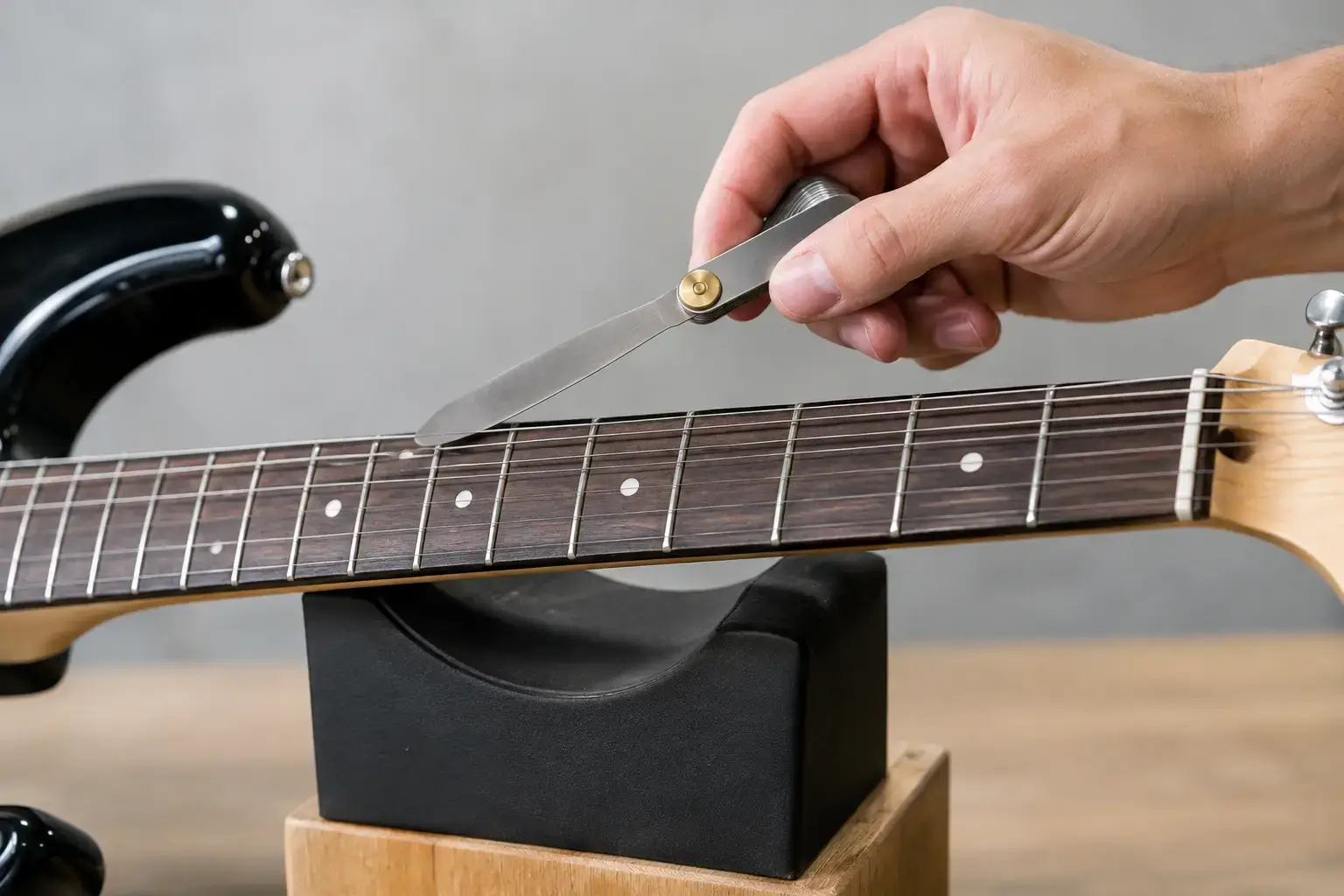
A guitar can have low action at the 12th fret and still feel stiff, buzzy or uneven under the fingers. The reason is often found earlier in the setup process: the relationship between the strings and the frets along the full length of the neck. So, what is guitar neck relief? It is the very slight forward curve deliberately set into a neck to give vibrating strings the clearance they need.
Relief is measured in small fractions of a millimetre, but it has a noticeable effect on how an instrument plays. Too little can make open-position chords rattle and cause notes to choke when played firmly. Too much can leave the guitar feeling unnecessarily high and resistant, even if the bridge action looks reasonable. The useful setting is not a fixed number copied from the internet. It depends on the instrument, fret condition, string gauge, tuning and, crucially, the player’s touch.
What is guitar neck relief in practical terms?
A correctly adjusted neck is not normally dead straight. When a string is played, it does not travel in a perfectly narrow line. It vibrates in an arc, with the greatest movement around the middle of its speaking length. A small amount of forward bow, sometimes called up-bow, provides room for that movement above the frets.
To assess relief, a technician effectively uses the string as a straightedge. The string is held down at the first fret and at the fret where the neck joins the body, or at the final fret on some instruments. The tiny gap between the underside of the string and the crown of a fret around the middle of the neck is the relief.
That gap is not the same thing as string action. Action describes string height above the frets at a specified point, often the 12th fret. Relief describes the neck’s curve. The two settings influence each other, but they must be assessed separately. Raising bridge saddles to hide an incorrect relief setting may reduce buzz, but it can also make the guitar harder to play and leave the underlying issue unresolved.
Why the right amount is player-specific
A lightly picked jazz player using .010 strings in standard tuning may be comfortable with a very modest amount of relief. A hard-hitting rhythm player, or a guitarist using heavier strings and dropped tuning, may need more clearance through the lower and middle positions. Bass guitars usually require their own approach because of their longer scale length, string excursion and playing force.
There is also no universal rule that more relief equals less buzz. Excessive relief can create a hollow or uneven feel in the middle of the neck, while the action at the body end remains high. Conversely, a very straight neck can play exceptionally cleanly when the frets are level, the nut is cut accurately and the player has a controlled touch. It depends on the complete geometry, not a single measurement.
At RG Guitar Tech, relief is considered alongside the player’s preferred strings, tuning, picking attack, action target and the real condition of the fretboard. This gives a setup a useful purpose: it should suit the way the instrument is actually played, not simply meet a generic specification.
The truss rod controls relief, but it is not a cure-all
Most modern guitars and basses use an adjustable truss rod inside the neck. Its job is to counter the pull of the strings and control the amount of forward bow. Tightening the rod generally reduces relief and straightens the neck. Loosening it generally allows more relief. The direction can vary in effect on unusual designs, dual-action rods and left-handed instruments, so it is sensible to understand the hardware before turning anything.
A truss rod adjustment should be small, deliberate and measured. It is not a volume control for fret buzz. If a neck is adjusted without checking the nut, frets, saddle heights and tuning, the result can be misleading. A guitar may appear improved at the bench but buzz again when returned to pitch, played harder or used with a capo.
The rod also cannot correct every neck problem. Uneven or worn frets, a local rise where the neck meets the body, a loose fret, a twisted neck or poor nut-slot geometry need separate diagnosis. For example, buzzing concentrated on one or two frets is less likely to be a simple relief issue than buzzing across a broad area of the neck.
Relief, back-bow and forward bow
A neck with too little relief may be straight or may have back-bow, where the centre of the neck sits slightly higher than the ends. This commonly produces buzzing around the first few frets, particularly when notes are picked firmly. In severe cases, the guitar can feel clean above the seventh fret but unpleasant for open chords and riffs.
Too much forward bow usually produces higher action around the middle of the fretboard. Players may describe the guitar as feeling hard work, sluggish or oddly high despite sensible saddle measurements. The cure is not automatically to tighten the rod. First, the neck must be measured accurately and the fret plane checked.
How neck relief is measured properly
Visual checks can reveal an obvious problem, but they are not precise enough for a player-specific setup. Looking down the neck can be useful, yet reflections, fret wear and the natural taper of the fretboard can distort what the eye sees.
A proper workshop assessment starts with the guitar at playing pitch and with the strings intended for use. The neck is checked under tension, not as a loose component on a bench. Relief is then measured at the appropriate area of the fretboard with accurate gauges and straightedges. A full-neck digital relief map can reveal whether the curve is consistent or whether there are local irregularities that a single centre measurement would miss.
The fretwork matters just as much. Under-string fret assessment identifies high spots that may cause buzzing even where relief is correct. It also helps distinguish a global setup adjustment from a fret-level, dressing or local repair requirement. This is why two guitars with the same relief figure can perform very differently.
Typical measurements are starting points, not promises
Technicians often work within familiar measurement ranges, but those figures are reference points rather than guarantees of playability. A well-fretted electric guitar with a light touch may work happily with minimal relief. An acoustic with stronger string tension may require a little more, while a bass may need enough room to keep low notes clear without making the instrument feel slow.
The meaningful test is how the guitar performs across the neck. Notes should speak cleanly at the desired attack level, bends should not choke unexpectedly, chords should remain comfortable and intonation should be checked once the relief and action have settled. Measurements guide the work; play-testing confirms it.
Symptoms that can point to a relief problem
Relief is worth checking when a guitar has changed noticeably without any other obvious cause. Seasonal humidity shifts can move wooden necks, as can a switch in string gauge, a new tuning or a change in playing style. A guitar that travelled well in a case during winter may need a fresh assessment after weeks in a warm, dry room.
Common signs include widespread fret buzz in lower positions, a high and springy feel around the middle frets, inconsistent action from one area of the neck to another, or a setup that seems to need constant bridge-saddle changes. These are clues, not diagnoses. A low nut slot can mimic low-fret buzz, and worn frets can make a neck feel inconsistent even with sensible relief.
If the instrument suddenly develops a major curve, the truss rod feels seized, or the neck shows a visible twist, stop before forcing an adjustment. The right next step is inspection, not extra leverage.
Relief is only one part of setup geometry
A reliable setup follows an order. Neck relief is established first because it affects the rest of the measurements. Nut-slot height, bridge action, fret condition, fall-away in the upper register, pickup height and intonation are then checked in relation to that foundation.
This order matters. Altering relief after setting action can change the feel and require the saddles to be revisited. Changing string gauge or tuning can alter tension enough to require another check. A documented setup records these measurements so future work starts from known information rather than guesswork.
The best neck relief is the one that lets your guitar respond cleanly to your normal playing, at an action you genuinely enjoy. If it is buzzing, fighting you or changing with the seasons, treat that as useful information about the instrument’s setup rather than something to play around.