The first sign is usually felt before it is seen: a familiar chord starts to buzz, a bend catches under the fingertip, or a note high on the neck chokes out despite the action seeming reasonable. Players often ask, “what causes guitar fret wear?” because the answer affects whether a setup will solve the problem or whether the fretwork itself now needs attention.
Fret wear is normal. Frets are sacrificial playing surfaces, designed to take the repeated contact of metal strings so the fingerboard does not have to. The useful question is not whether a guitar has wear, but where it is, how deep it is, and whether it is now affecting string-contact points, action, tuning or intonation.
What causes guitar fret wear most often?
The short answer is repeated string contact under pressure and movement. Every time a string is fretted, it is pressed down on to the crown of the fret. Add bends, vibrato, slides and years of chord playing in the same positions, and the crown gradually becomes flatter. Eventually, a visible groove develops beneath the strings.
Most traditional frets are nickel silver, despite the name containing no silver. It is a workable, musical-sounding material and remains common for good reason, but it is softer than the steel used in guitar strings. Stainless-steel frets resist wear far longer, although they are more demanding to install and dress properly. Neither material is immune to damage or poor geometry.
Wear tends to be concentrated rather than even. On many electric guitars, frets one to five show the clearest marks because open-chord shapes, riffs and common scale patterns live there. A player who spends most of their time bending in the pentatonic positions may create pronounced wear under the plain strings around the seventh to twelfth frets. Acoustic players can show heavier first-position wear, while basses often reveal broad marks beneath the lower strings in their most-used positions.
String pressure and playing style
Heavy fretting pressure accelerates wear. Pressing harder than necessary does not normally make a note sound better, but it does push the string more firmly into the fret and can pull it sharp. Players with a strong grip may also find that worn areas appear sooner, particularly when using lower, narrower frets.
Bending and wide vibrato add a sideways scraping action. This is not a reason to avoid expressive playing – it is simply why a blues or rock guitar can wear differently from a lightly played jazz instrument. Slides, aggressive rhythm work and repeated use of a capo can also leave their own pattern.
String gauge matters, but not in isolation. Heavier strings generally apply more force when fretted at pitch, yet a lighter set played with forceful bends can still wear frets quickly. Tuning, scale length, fret material and technique all change the result. A guitar in standard tuning with .010s may wear more quickly in the hands of one player than a .012-set acoustic played gently by another.
Dirty or corroded strings
Old strings collect skin oils, oxidation and fine abrasive particles from hands, stages, rehearsal rooms and cases. That residue can turn normal string contact into more abrasive contact, especially if the strings feel rough or discoloured. It will not transform a fresh fretboard into a disaster overnight, but across hundreds of playing hours it contributes.
Changing strings when they have lost their smoothness helps protect frets as well as improving tone and tuning stability. Wiping strings after playing is a sensible habit, particularly for players with naturally acidic perspiration. It is a small maintenance step with a real cumulative benefit.
Fret material, finish and previous work
Not all fretwire has the same hardness, height or width. Vintage-style nickel-silver wire can wear relatively quickly, while harder wire retains its crown longer. A lower fret starts with less usable height, so even modest wear can become noticeable sooner than it would on tall wire.
Previous fretwork also matters. A guitar that has already been levelled has less fret height remaining than it had when new. That does not mean the work was wrong – a careful level and crown can restore excellent playability – but there is a finite amount of material available before a refret becomes the more sensible repair.
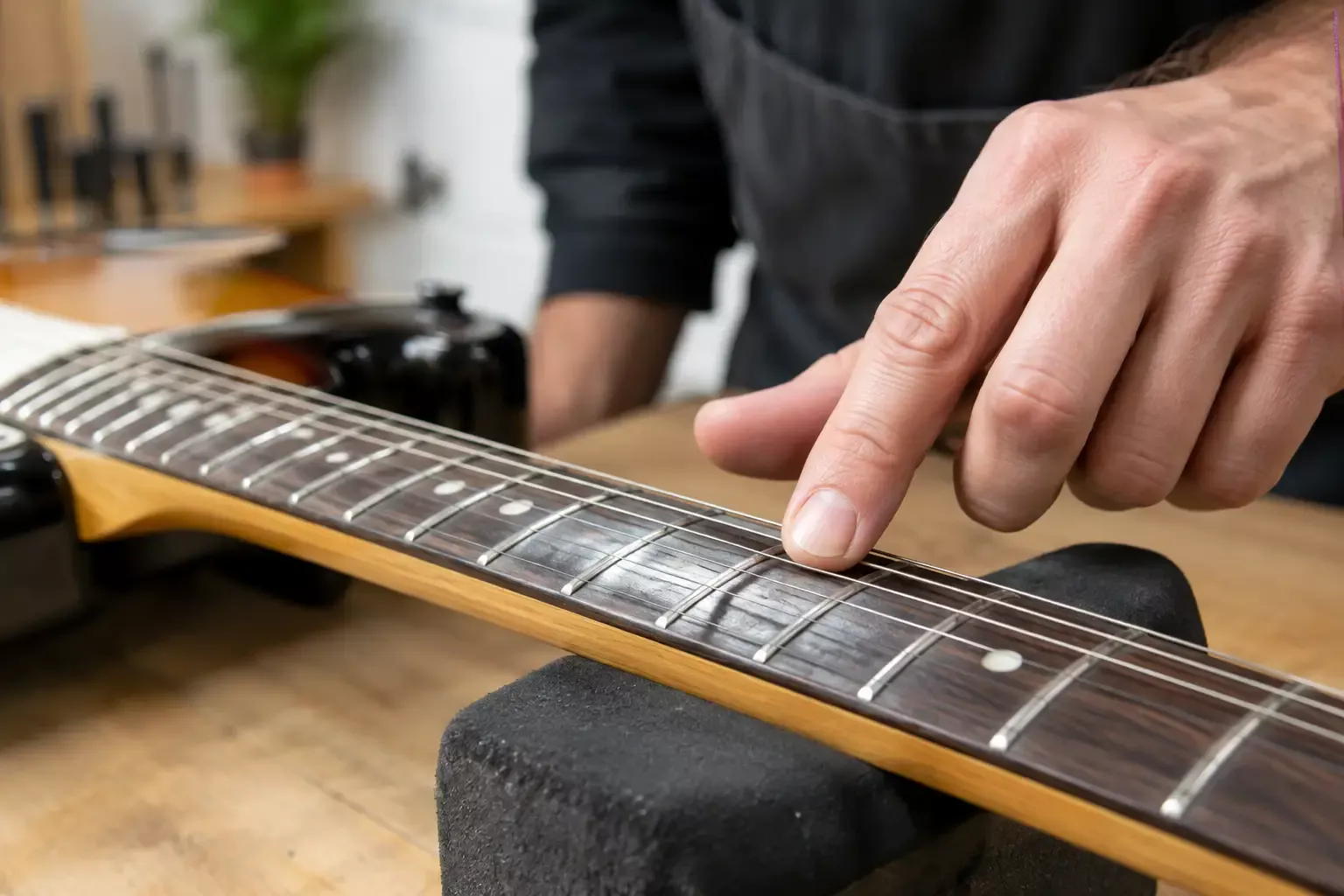
Poorly finished fretwork can complicate matters too. Frets that were left uneven, insufficiently crowned or poorly seated may produce buzz and dead notes that look like wear symptoms. A visual inspection alone is not enough. The neck needs to be assessed under appropriate string tension, with relief, fret height and playing action considered together.
Wear is not always the cause of the buzz
A groove in a fret does not automatically explain every rattle or choked note. Neck relief can change with seasonal humidity, string gauge changes alter tension, and a high or loose fret can create a localised problem that has nothing to do with an obvious groove. On electric guitars, an action set very low for a light touch may buzz for a player with a heavier attack even when the frets are in good order.
This is why broad statements such as “the frets are worn out” can be unhelpful. The relevant issue is fret geometry. If a string lands in a worn flat rather than on a rounded crown, its contact point becomes less precise. That can affect clean fretting, sustain and intonation. If a worn fret is lower than its neighbours, the next fret can interfere with the vibrating string and cause choking or buzzing.
At RG Guitar Tech, this is assessed as a measurement-led job rather than a guess based on one noisy note. Relief mapping, under-string fret assessment and a close inspection of the crowns reveal whether the problem is isolated, tension-dependent or spread across the neck. The final setup should suit the player’s string gauge, tuning, action preference and right-hand attack – not a generic factory figure.
Environmental damage can make wear look worse
Humidity does not wear a fret in the way a string does, but it can move wood enough to expose or exaggerate fret problems. A dry fingerboard may shrink slightly, leaving fret ends proud. Moisture changes can alter neck relief and create a different pattern of buzzes from one season to the next.
Corrosion is another issue. Damp storage, a cold garage, a poorly sealed case or long periods without use can tarnish frets and strings. Corroded fret crowns feel rough, increase friction during bends and may need cleaning, polishing or more involved attention. Keeping an instrument in a reasonably stable indoor environment is far kinder to it than leaving it near a radiator, external wall or car boot.
When does fret wear need repair?
Light flattening is not necessarily a fault. Many well-played guitars have small marks that do not affect feel or accuracy. If the guitar plays cleanly, intonates correctly and has enough adjustment range, there may be no reason to remove fret material simply because wear is visible.
Repair becomes worthwhile when grooves catch the string, bends choke unexpectedly, notes buzz in specific places, action cannot be set comfortably, or intonation remains unsettled after the usual setup checks. A player may also notice that some fretted notes need noticeably more pressure to sound cleanly.
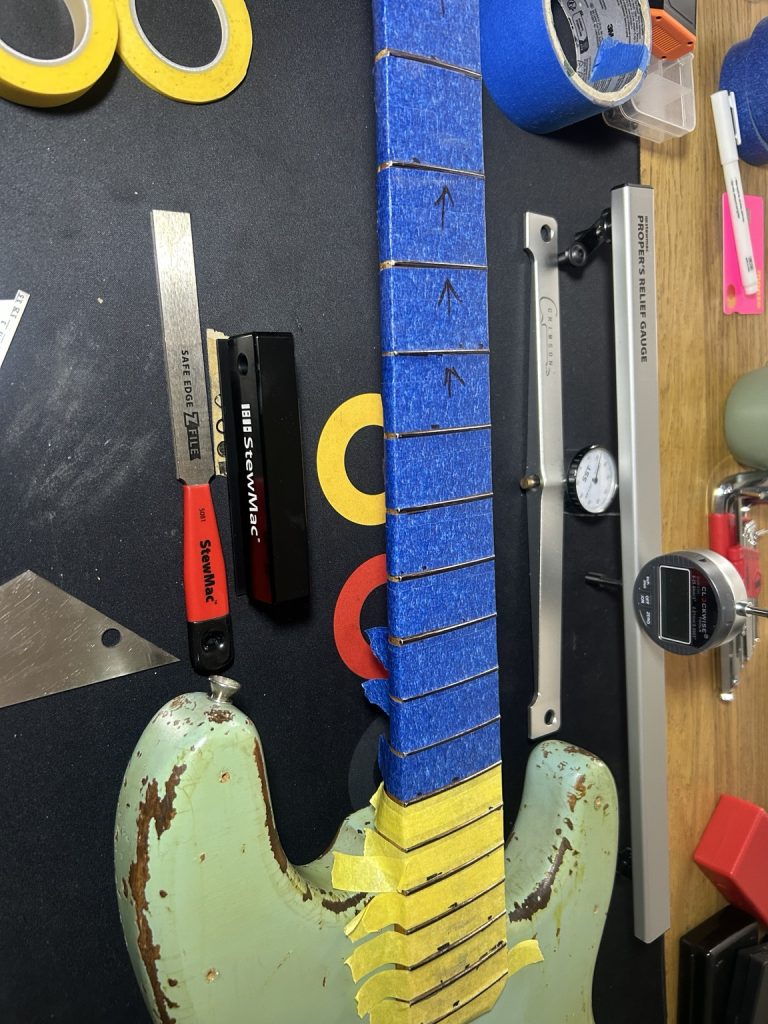
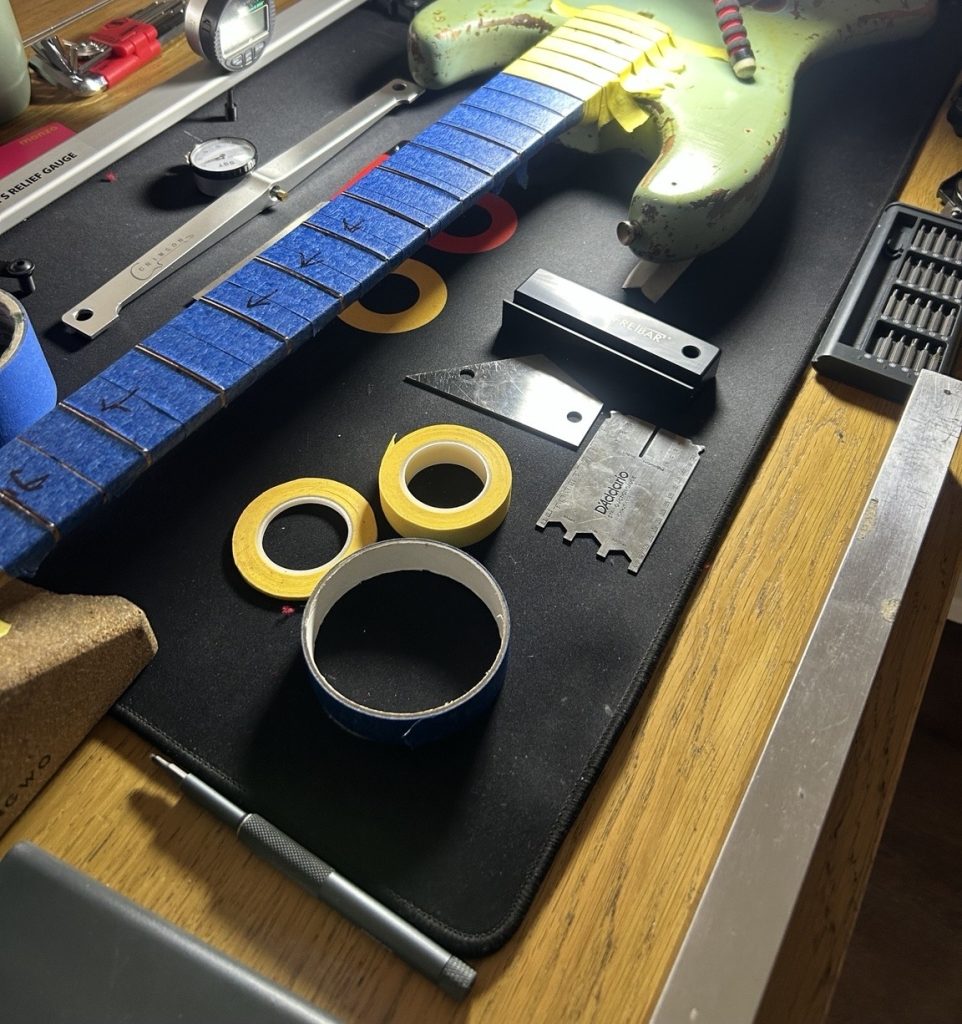
The appropriate remedy depends on the remaining fret height and the condition of the whole neck. A fret level, crown and polish can restore a consistent plane when there is sufficient material left. The levelling process lowers the highest points, then each fret is re-crowned so the string meets a defined contact point rather than a broad flat surface. Done properly, this can produce lower, cleaner action and more dependable intonation.
There is a trade-off. Levelling cannot put height back into frets, and removing too much material from already low wire can make a guitar less comfortable rather than more playable. Where grooves are deep or the frets have been dressed several times, a refret may be the honest long-term answer. Partial refrets can work in particular cases, but matching old and new fret height requires careful judgement and is not automatically the cheapest or best route.
Reducing future fret wear
You cannot play a guitar for decades without leaving some evidence of it, nor should you treat an instrument as a museum piece if it is meant to make music. The aim is simply to slow unnecessary wear and catch developing problems early.
Keep strings clean and replace them before they become rough. Use the minimum fretting pressure needed for a clean note, especially when practising slowly. Have the guitar checked after a significant string-gauge or tuning change, and do not ignore a new buzz that persists after a basic setup check. A well-set nut, sensible relief and action matched to your touch reduce the temptation to fight the instrument.
A worn fret is not a verdict on a guitar’s future. It is useful evidence of how that instrument has been played and where it needs attention. Address it before the grooves become severe, and the result is usually a guitar that feels more accurate under the fingers, stays cleaner across the neck and is ready to be relied on at the next rehearsal or gig.