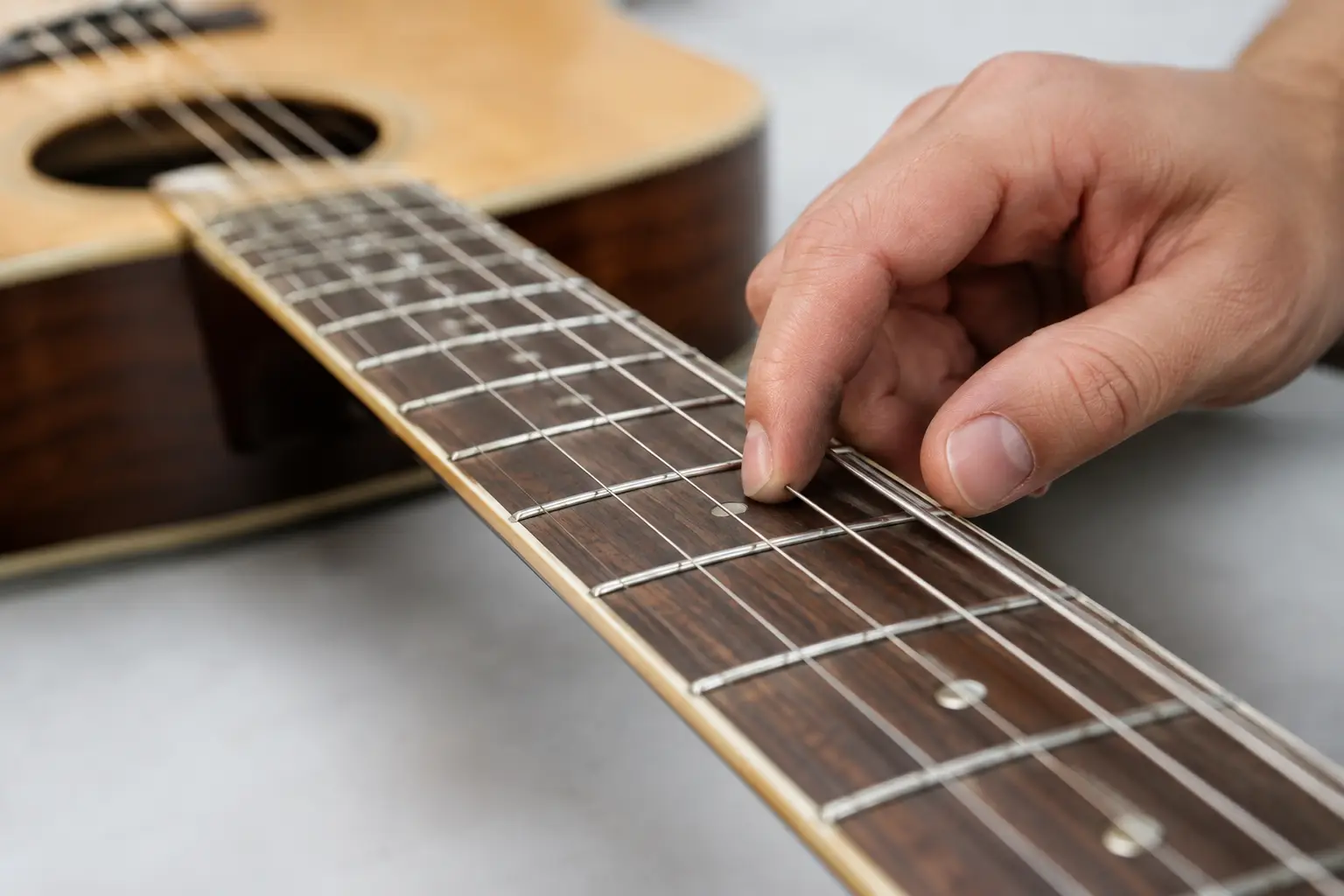
A guitar can look well cared for and still feel increasingly difficult to play. The most telling signs guitar frets need replacement are rarely cosmetic alone: notes choke during bends, familiar chords buzz despite a sensible setup, and intonation begins to drift because the string is no longer leaving a clean contact point.
Frets are consumable playing surfaces. Every bend, vibrato movement and string change gradually reshapes the crown, particularly under the plain strings and in the first-position areas where most players spend their time. The question is not simply whether a fret has marks. It is whether those marks have changed the geometry enough to affect feel, pitch and reliability.
Signs guitar frets need replacement
Deep grooves or flattened fret crowns
The classic sign is a visible groove beneath the B and high E strings, often around frets one to seven. A shallow mark may be harmless, but a deep divot creates an uneven surface that prevents clean string clearance. You may hear a sitar-like buzz, feel the string catch during bends, or find that a note loses sustain earlier than it should.
Flattening matters too. A correctly finished fret has a narrow, rounded crown. That defined peak gives the string a consistent contact point. As the crown becomes broad and flat, intonation becomes less precise and the guitar can feel less responsive under the fingertips. Heavy-handed players, players using stainless steel strings, and instruments that see regular gigging tend to show this wear sooner.
Buzz or choking that returns after adjustment
Buzzing does not automatically mean worn frets. Neck relief, action, nut-slot height, bridge condition and playing attack all need checking first. A guitar set very low for a light touch may be perfectly practical, while the same settings will rattle under a firm rhythm player.
The concern is buzz that remains localised to certain frets after the neck and bridge have been correctly assessed. If a note consistently chokes on a bend at the same point, a low or worn fret may be interrupting the string path. Equally, if raising the action only partly improves the issue, the fretboard may need levelling work rather than another general setup.
Dead notes and uneven sustain
A dead note is not always completely silent. More often, it has a noticeably shorter decay, a duller attack or an abrupt loss of volume compared with adjacent notes. On an electric guitar, this can be mistaken for a pickup or amplifier problem. On an acoustic, it can make a good instrument feel strangely unresponsive.
A worn fret can contribute, but so can a raised fret, a fret that has lifted slightly from the slot, or a neck with uneven movement across its length. This is why diagnosis matters. Filing the visible fret in isolation without measuring the surrounding area can make the underlying geometry worse.
Intonation that will not settle
If the open strings tune accurately but fretted notes remain sharp or inconsistent after bridge intonation is set, look at the fret crowns. The string should break cleanly from the highest point of the fret. When crowns are heavily flattened, pitted or uneven, that contact point becomes less defined.
There are limits to what intonation adjustment can correct. String age, gauge, tuning, nut-slot height and player pressure all have an effect. However, when a player has to retune constantly to make ordinary chord shapes sound acceptable, worn fretwork deserves inspection.
Sharp fret ends alongside playing wear
Sharp fret ends are usually caused by a dry fingerboard shrinking around the fret tangs, rather than fret wear itself. But on an older or hard-worked guitar, they can arrive alongside low crowns, loose frets and a generally tired playing surface.
The two issues need treating separately. Fret-end dressing improves comfort at the edge of the neck. It does not restore fret height or correct divots across the playing area. A proper assessment establishes whether the instrument needs edge work, a level and crown, or a full re-fret.
When a fret level and dress is enough
Replacement is not always the right answer. If there is adequate fret height remaining and the wear is relatively shallow, a fret level, crown and polish can restore a remarkably clean playing surface. The frets are first assessed under string tension, because some problems only reveal themselves when the neck is loaded as it is in normal playing.
The high points are then reduced carefully, the crowns are reshaped to restore a precise string-contact point, and the frets are polished. A final setup brings neck relief, action, nut slots, pickup height and intonation back into balance for the player’s string gauge, tuning and technique.
There is a trade-off. Levelling removes material from every fret to create an even plane. If the frets are already low, repeated levelling can leave too little height for comfortable bending and clean future maintenance. A quick fix is not good value if it leaves the guitar needing a re-fret shortly afterwards.
When a re-fret is the sensible repair
A re-fret becomes the better long-term option when divots are deep, fret crowns are too low to reshape properly, or previous levelling has used up the available material. It may also be appropriate where frets have persistent lifting, corrosion, poorly fitted replacement frets or extensive unevenness across the board.
A full re-fret is more involved than removing and replacing wire. The fingerboard condition, fret-slot integrity, neck geometry and desired fretwire size all need consideration. On vintage instruments, preserving original character may be part of the brief. On a modern working guitar, the priority may be durable wire, low clean action and dependable performance night after night.
Fretwire choice changes the result. Taller wire can make bends feel easier and gives more material for future dressing, but it also makes heavy fretting pressure more likely to pull notes sharp. Wider wire can feel substantial and wear well, while narrower profiles may suit players who prefer a more traditional feel. There is no universal upgrade. The right choice depends on hand pressure, string gauge, radius, style and how the instrument is used.
Problems that can look like worn frets
Before committing to fretwork, a technician should rule out a few common causes. A neck with insufficient or excessive relief can create buzz patterns that resemble uneven frets. Nut slots cut too low cause open-string buzz that disappears when the first fret is held down. A poorly seated bridge saddle, loose hardware or a worn string can introduce noises that seem to come from the fingerboard.
Humidity and temperature changes also matter, especially on acoustics and instruments stored near radiators or in cold cars. Wood moves. A fretboard can develop tension-dependent fret problems even where the fretwork was previously sound.
This is why measurement-led inspection is preferable to guessing from one symptom. Full-neck relief mapping and under-string fret assessment show how the neck behaves in playable conditions. The aim is not merely to remove buzz. It is to establish a stable geometry that suits the player without forcing unnecessarily high action.
A simple check you can make at home
Under good light, look across the frets from the bridge end of the guitar. Flat patches and grooves often become clearer when viewed at a shallow angle. Run a fingertip gently along the strings around the most-used positions: a pronounced notch can usually be felt even if it is difficult to photograph.
Then play every note on each string, both softly and with your normal attack. Make a note of where buzzing, choking or weak sustain occurs. Test bends where you would normally use them rather than only playing single notes straight up the neck. These observations are useful, but they are not a substitute for measured inspection. Avoid trying to file individual frets at home, as it is very easy to create a low spot or spoil the crown profile.
Get the repair that preserves the guitar
A well-executed fret repair should make the instrument feel familiar again, not simply different. Chords should speak cleanly, bends should travel without choking, and the action should sit at a height that matches your hands rather than an arbitrary number.
RG Guitar Tech assesses fret condition alongside the complete setup, so the recommendation is based on what the guitar needs: adjustment, local fret attention, a level and dress, or a re-fret. For players in Nottingham and surrounding areas, or UK customers using the repair-by-post service, documenting the symptoms before inspection helps turn an irritating playing problem into a clear, proportionate repair decision.
If your guitar has started making you work around certain notes, do not wait until a groove becomes a crater. Early assessment often preserves more fret height, keeps the cost proportionate and gets a trusted instrument back to feeling ready for rehearsal, recording or the next gig.