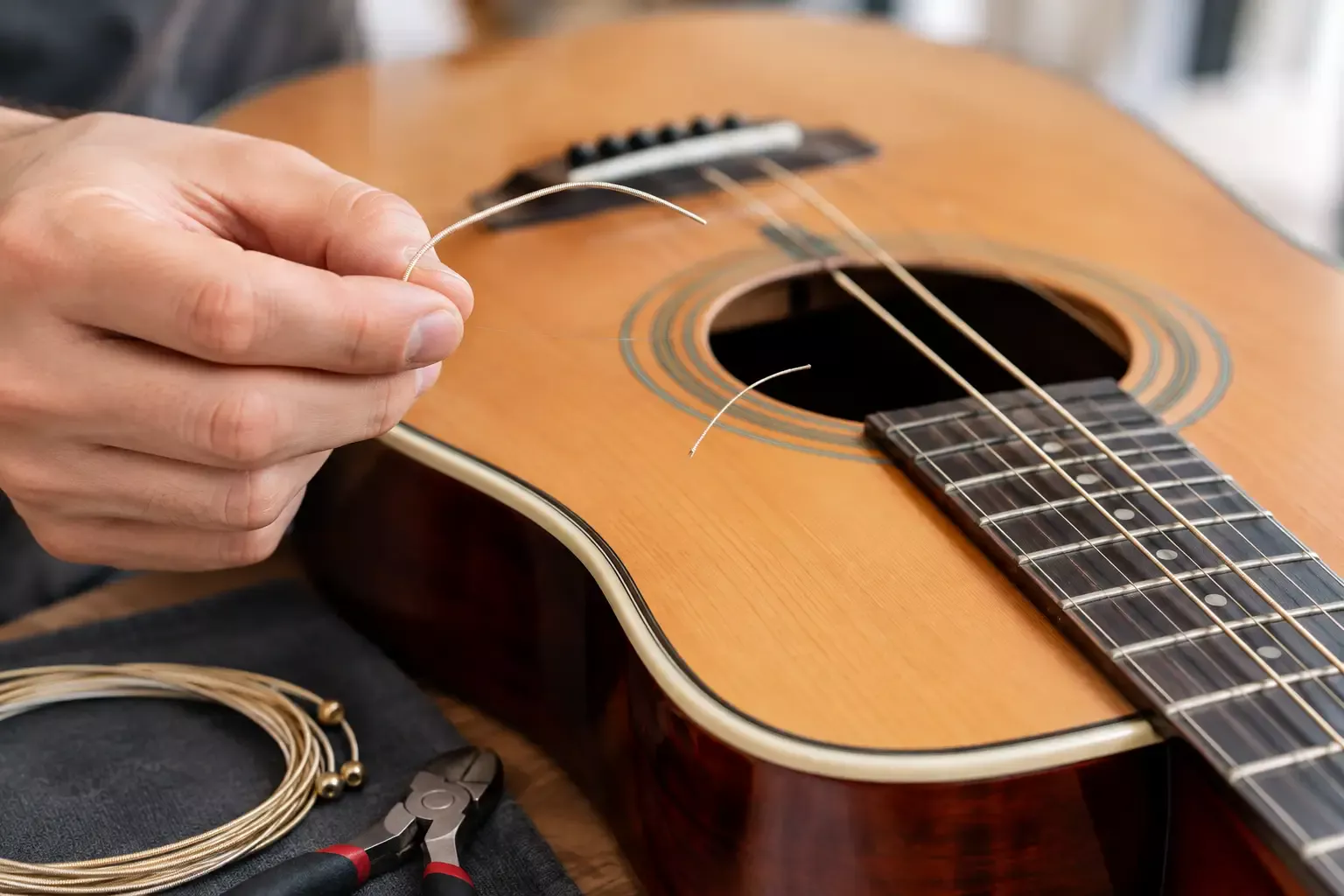
A string snapping halfway through a rehearsal is frustrating. A string snapping in the same place, on the same guitar, more than once is useful information. When players ask why guitar strings break frequently, the answer is rarely simply that they need a stronger brand of strings. More often, the guitar has a sharp contact point, an unsuitable setup for its tuning, or a part that is allowing the string to rub where it should glide.
Strings are consumable, and any string can fail eventually. Sweat, hard picking, wide bends and hours of playing all shorten their life. But a healthy, correctly set-up guitar should not repeatedly eat strings at the bridge, nut or tuning post. The break location is the first clue.
Why guitar strings break frequently at the same point
Look closely at the broken end before removing the string. If it has snapped right at the bridge saddle, nut, tree, retainer or tuner post, that contact point deserves inspection. A clean break at one fixed location is usually mechanical. A break in the middle of the speaking length is more likely to relate to string age, heavy use, corrosion or an unusually forceful playing style.
The most common causes are small burrs, grooves and edges that are difficult to see but easy for a vibrating string to find. A saddle may have a tiny sharp ridge left by wear or damage. A nut slot may be too narrow for the installed gauge, pinching the string during tuning. A string tree can develop a rough underside, while a poorly finished tuner hole can cut into the wrap as the string is brought to pitch.
This is why simply fitting another set may solve the problem for a day, then create the same failure at the next gig. The underlying contact point has not changed.
Bridge saddles and tremolo systems
On fixed bridges, the string’s main stress point is often the saddle witness point: the precise place where the string leaves the saddle towards the fretboard. That point needs to be smooth and correctly formed, not sharp, flat-spotted or deeply notched. On acoustic guitars, inspect the bridge pin, the edge of the bridge-pin hole and the bridge plate area as well. A ball end that is not seated properly can move under tension and cause unusual wear.
Tremolo-equipped guitars add more possible contact points. The string can catch at the saddle, the tremolo block, a locking nut, a retainer, or even at a point where the string rubs against bridge hardware during movement. A floating tremolo also changes tension across the set when one string breaks, which is why a single failure can put the whole instrument out of tune so dramatically.
The repair is not always replacement hardware. Often, careful dressing and polishing of the relevant contact surface is enough. If a saddle is badly worn, cracked or incorrectly shaped, replacement is the more reliable option.
Nut slots that are too tight or poorly shaped
The nut controls the string’s starting point at the headstock end. Its slots must match the gauge and material of the strings fitted, with enough clearance for the string to move smoothly during tuning and bending. A .010 string in a slot cut for a .009 may bind. A wound string in a slot that is narrow, rough or cut at the wrong angle can be damaged gradually every time it is tuned.
Binding does not only cause breakage. It commonly produces tuning instability: the string sticks in the slot, then releases suddenly with a ping. Players often respond by turning the tuner back and forth, increasing stress and making the guitar feel unpredictable.
A properly cut nut is not just a matter of making the slots wider. Slot depth, break angle, floor shape and the direction of the exit towards the tuners all matter. Removing too much material creates open-string buzz and can alter feel in first position. This is precision work, particularly on vintage instruments and guitars with replacement nuts of uncertain quality.
String gauge, tuning and tension must agree
A setup is tension-dependent. Change the gauge or tuning and you change the pull on the neck, the behaviour of the bridge and the way the strings sit in the nut and saddles. Moving from standard tuning to drop C with the same light set may leave the lower strings slack and unstable. Moving to a heavier set without checking the nut can create binding and premature failures.
There is no universal best gauge. A player using .009s in standard tuning with a light touch may have no problem at all. A player tuning down, picking hard and using wide vibrato may need more tension from a heavier gauge or a different scale length. The trade-off is that heavier strings place more load on the neck and may require nut-slot adjustment, relief correction, action adjustment and fresh intonation.
Extended-range and baritone guitars need the same consideration. Low tunings can be made playable with many gauge combinations, but the string must have sufficient tension to speak cleanly and return to pitch consistently. A string that feels overly loose can slap against frets, shift at the saddle and encourage aggressive picking that shortens its life further.
Old strings do not always look old
Corrosion is a quiet string killer. Finger moisture, skin oils and residue collect around the fretting area and under the windings of the bass strings. The plain strings can develop microscopic weak points that are not visible until they fail. If a guitar is used regularly, especially under hot stage lighting or in long rehearsals, waiting until strings look visibly dull is often too late.
How often to change strings depends on the player. A home player with dry hands may get months from a set. A working musician with acidic sweat may need a fresh set before every important performance. Coated strings can extend usable life for some players, but they will not overcome a burr in a saddle or a nut slot that is pinching.
Wiping down the strings after playing helps. So does cleaning the fretboard and bridge area when restringing, because grime around the saddles and nut can conceal the evidence of where a string is rubbing.
Restringing mistakes that create avoidable stress
A string can be damaged before the guitar is even tuned. Kinking the plain strings sharply, pulling the wound strings hard around a narrow edge, or repeatedly unwinding and rewinding the same section all weaken the metal. Once a string has been creased near the tuning post or bridge, replacement is usually wiser than trying to save it.
At the tuner, use enough wraps for a stable hold without creating an untidy coil that overlaps itself. Too few wraps can slip; too many can cause the winding to bind and make tuning less predictable. Locking tuners reduce the need for wraps, but the string still needs to be trimmed and clamped cleanly without crushing it.
On guitars with a tremolo, stretch new strings gradually and retune several times before judging stability. Stretching does not mean hauling the string violently away from the fretboard. Controlled, moderate stretching removes slack from the wraps and ball end while avoiding unnecessary damage.
When playing technique is part of the answer
Technique can shorten string life, but it should not be used as a catch-all explanation. Heavy downstrokes, aggressive bends, frequent double-stop bends and a very hard picking attack place genuine extra load on strings. Players who work this way may need to accept more frequent changes, especially on high E and B strings.
However, a guitar should still be able to handle normal expressive playing. If the high E breaks every few rehearsals at the saddle, the sensible first step is to inspect the saddle, not to tell the player to bend less. The instrument needs to support the job it is used for.
Plectrum choice can also affect wear. A thick, pointed plectrum used with a sharp angle of attack can produce more friction than a rounded pick held flatter to the string. That does not mean one choice is correct. It means the setup, string gauge and maintenance schedule should suit the way you actually play.
A practical diagnosis before the next string change
Before fitting a new set, identify the failed string, its gauge, how long it lasted and exactly where it broke. Check the saddle and nut under good light. Run a small piece of cotton wool gently over suspect edges: fibres catching can reveal a burr that your fingertip misses. Do not use a file casually on a nut or saddle. It is easy to turn a small problem into an inaccurate string-contact point.
If breakages are paired with tuning problems, fret buzz, a recent gauge change or altered tuning, treat the guitar as a complete setup issue. Neck relief, action, saddle position, nut fit and string tension work together. Correcting only the visible symptom can leave the real cause in place.
At RG Guitar Tech, a repeat-breakage fault is assessed as part of the instrument’s overall geometry, not as an isolated annoyance. The aim is a smooth path from tuner to bridge, stable tuning under your normal playing pressure, accurate intonation and a guitar that is ready to rely on.
A fresh set of strings should feel like routine maintenance, not a countdown to the next snap. If yours repeatedly fail at the same point, keep the broken string, note where it happened, and have that contact point checked before the next rehearsal or show.